How Stem Separation Works: A Complete Guide for Music Producers and Sound Engineers in 2026
Discover how stem separation and AI audio tools power modern music production in 2026.
How Stem Separation Works
In the constantly evolving world of music production, 2026 stands as the year when artificial intelligence has fully transformed sound engineering workflows. Among the most revolutionary techniques reshaping how producers and engineers think about mix control is stem separation. Once a complex task requiring advanced manual editing, stem separation now allows creators to split any mixed track into distinct, editable components using advanced AI audio tools.
What Is Stem Separation and Why Does It Matter?
Stem separation refers to the process of dissecting a mixed audio track into individual sound layers – often referred to as stems. These stems typically include vocals, drums, bass, guitars, accompaniment, and sometimes other instrumental layers. The goal is to enable detailed editing and remixing without needing the original multitrack session files.

For a music producer, this is an incredible advantage. Consider having access to only a song’s stereo mix; with modern stem separation, you can isolate the vocal track, clean up the percussion, or even re-arrange musical sections for live performances or covers. This process has become central to audio source separation, a technical field that uses algorithms to distinguish overlapping frequencies in a recording.
The practical implications go well beyond remixing. Stem separation helps with:
- Vocal isolation for karaoke or vocal practice
- Educational analysis of professional mixes
- Audio restoration and clean-up in post-production
- Sampling and creative remixing
In earlier years, manual EQ filtering or multiband compression were used with partial success. In contrast, 2026’s AI-driven methods grant far more precision by using neural networks trained on thousands of instrument profiles.
How Does Stem Separation Work Technically?
Modern stem separation uses deep learning-based source separation models that interpret complex audio signals much like computer vision algorithms analyze images. The process begins by feeding a mixed track into an AI model that maps frequency and time domains (via spectrogram analysis). Each sound type produces distinctive frequency patterns—like the percussive bursts of drums or the sustained harmonics of vocals.

These models, refined between 2024 and 2025, have reached near studio-grade accuracy by 2026. They detect these spectral signatures and extract them into separate audio files or “stems.” Each stem is processed through adaptive filtering to minimize artifacts and maintain high fidelity. This results in clean and usable elements ready for editing in any music production technology platform. For a deeper dive, watch our guide on creating Deep House music and how to make music on the Soundverse YouTube channel.
What Are the Most Common Applications of Stem Separation?
By 2026, stem separation technology has expanded into multiple domains across audio engineering, content creation, and music education. Here’s how professionals use it today:
- Remixing and Sampling: Producers can take commercially released tracks and rework them creatively by emphasizing isolated components. It’s an excellent way to create unique versions or mashups.
- Performance Preparation: Live artists and DJs separate stems to prepare custom backing tracks for performances.
- Karaoke Production: High-quality vocal isolation powers the next generation of karaoke tracks.
- Music Tutoring: Educators use stems to analyze mix structures, teaching balance and instrument dynamics.
- Podcasting and Content Creation: Stem isolation helps content creators clean up speech and background music segments for clearer audio.
- Film and Television Audio Editing: Audio professionals rework dialogues and music mixes efficiently.
Those who follow AI music innovations will recognize that these use cases closely parallel developments discussed in blogs such as AI ranks Soundverse’s AI Singer #1 — The Ultimate AI Singing Platform Dominating 2025 and How AI-Generated Music Is Transforming the Music Industry.
What Makes AI-Powered Stem Separation Better Than Traditional Methods?
Before AI-based stem separation matured, sound engineers had limited options for isolating stems. Manual frequency carving through equalizers or mid-side processing often left audible artifacts. But today’s AI audio tools outperform traditional techniques by learning contextual information—recognizing not only which frequencies belong to a specific instrument but also how they evolve dynamically across time.
This breakthrough improves:
- Clarity and Precision: AI separation models maintain clean frequency boundaries.
- Speed: Processes that took hours now take minutes.
- Creative Freedom: Artists can remix legacy songs or reinterpret classics instantly without access to original recordings.
Additionally, the integration of AI music production technology tools—like section labeling or automatic arrangement reconstruction—makes the workflow more intelligent. Many artists use these tools in tandem with AI generators similar to those discussed in Mubert Alternatives: Soundverse.
What Are the Challenges of Stem Separation Today?
Even in 2026, stem separation is not entirely foolproof. Some recordings, especially those heavily compressed or mastered aggressively, can cause instrument bleed across frequency bands. These challenges require fine-tuning of algorithm parameters. But the gap between automated and studio-level quality continues to shrink rapidly as AI improves.
Challenges include:
- Artifacts on dense mixes with overlapping tonal elements
- Quality loss during extreme isolation
- Processing time depending on model complexity
Still, as seen in emerging updates from AI music platforms and tools covered in Soundverse AI Revolutionizing Music Creation for New Age Content Creators, developers continue refining these systems to minimize such issues.
How AI Audio Tools and Music Production Technology Shape Stem Separation in 2026
The 2026 landscape of sound engineering closely integrates stem separation with other innovations like automated genre recognition and arrangement segmentation. Platforms capable of identifying structure (intro, verse, chorus, bridge, outro) empower producers to rearrange stems efficiently for new compositions. The harmony between section analysis and editable stems shortens workflow cycles drastically.
As AI-assisted music production technology advances, users can import separated stems directly into arrangement environments where they tweak sections, apply filters, or change the overall vibe. This synergy accelerates productivity and maintains creative control, paving the way for hybrid human-AI collaborations.
For creators interested in complementary tools, see What Is Soundverse Arrangement Studio and What Does It Do? to understand how separated stems fit into large collaborative projects.
How to Make Stem Separation with Soundverse Stem Separator
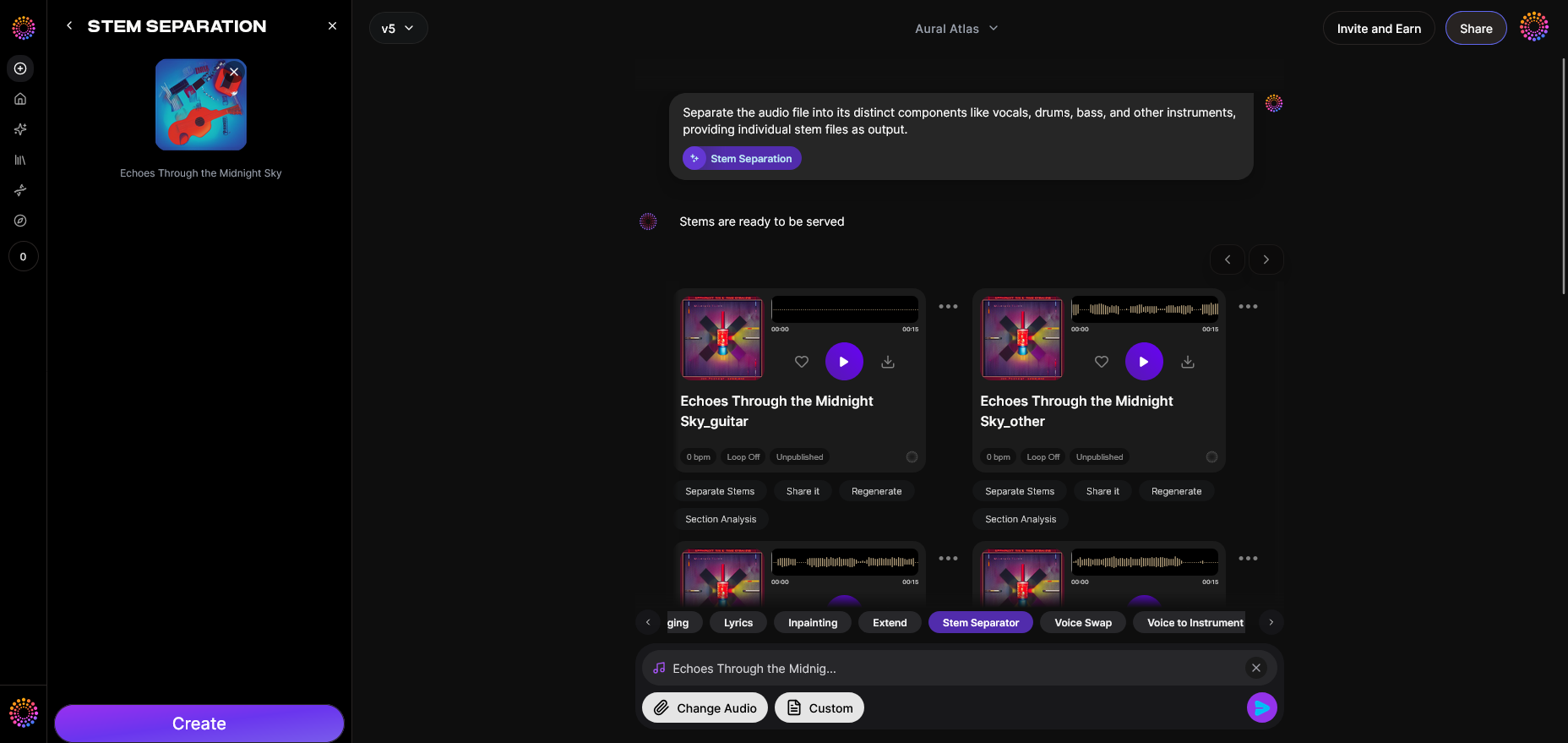
Now that you understand the fundamentals of stem separation and how it transforms modern sound engineering, here’s how you can achieve professional-quality results instantly using Soundverse Stem Separator.
Soundverse’s Stem Separator is designed to dissect mixed audio into up to six individual editable stems – Vocals, Drums, Bass, Guitar, and Accompaniment layers. It delivers high-quality isolation suitable for remixing, sampling, and educational analysis. You can input audio via URL, file upload, or direct recording. The tool processes the recording asynchronously (upload first, then AI separation) to ensure optimal results.
Core Workflow Steps
Step 1: Upload Interface
Begin by opening the Soundverse Stem Separator and selecting your audio input. You may upload a local file, paste a streaming link, or record directly. The interface ensures compatibility with various sources, making stem extraction easy for producers and engineers.
Step 2: Additional References
This step allows adding optional reference tracks to guide separation consistency. Producers working on remixes or cover versions often use this function to align arrangements or tonal profiles.
Step 3: Results Display
Once processing completes, Soundverse visualizes individual stems. Each separated component appears labeled—vocals, drums, bass, guitar, or accompaniment—helping you preview structure and verify accuracy before downloading.
Step 4: Download Stems
Finally, download each stem individually. These isolated tracks can be brought into any DAW for detailed mixing, mastering, or creative transformation. This asynchronous process ensures fidelity and balance across stems.
Why Soundverse Stands Out
Compared with other tools, Soundverse integrates seamlessly into broader production workflows where Section Analysis and Arrangement Studio enhance usability. After extracting stems, users can open them directly within Arrangement Studio for collaborative refinements or compositional rearrangement. This enables effortless remixing, cover creation, and teaching applications.
As described in Soundverse Introduces Stem Separation AI Magic Tool, the company’s AI framework focuses on precision and user convenience rather than raw real-time manipulation. It’s asynchronous, meaning upload first, process later—ensuring consistency and top-tier output quality.
Experience Stem Separation Magic Today
Unlock the power of AI technology to isolate vocals, instruments, and beats from any track with incredible accuracy. Enhance your mixes, create remixes effortlessly, and elevate your sound production workflow.
- Soundverse Introduces Stem Separation AI Magic Tool — Discover how Soundverse’s cutting-edge tool brings professional-level stem separation to creators of all skill levels.
- What Are Song Stems and Why Do You Need Them — Learn what song stems are and how understanding them can revolutionize the way you mix, master, and edit your music.
- Soundverse AI Revolutionizing Music Creation for New Age Content Creators — Explore how Soundverse AI empowers creators to produce high-quality, studio-ready tracks with innovative tools and intelligent features.
- AI Music Generator and Human Composers: A Future Together — Dive into how AI and human creativity coexist to shape the evolving landscape of music composition and production.
Here's how to make AI Music with Soundverse
Video Guide

Here’s another long walkthrough of how to use Soundverse AI.
Text Guide
- To know more about AI Magic Tools, check here.
- To know more about Soundverse Assistant, check here.
- To know more about Arrangement Studio, check here.
Soundverse is an AI Assistant that allows content creators and music makers to create original content in a flash using Generative AI. With the help of Soundverse Assistant and AI Magic Tools, our users get an unfair advantage over other creators to create audio and music content quickly, easily and cheaply. Soundverse Assistant is your ultimate music companion. You simply speak to the assistant to get your stuff done. The more you speak to it, the more it starts understanding you and your goals. AI Magic Tools help convert your creative dreams into tangible music and audio. Use AI Magic Tools such as text to music, stem separation, or lyrics generation to realise your content dreams faster. Soundverse is here to take music production to the next level. We're not just a digital audio workstation (DAW) competing with Ableton or Logic, we're building a completely new paradigm of easy and conversational content creation.
TikTok: https://www.tiktok.com/@soundverse.ai
Twitter: https://twitter.com/soundverse_ai
Instagram: https://www.instagram.com/soundverse.ai
LinkedIn: https://www.linkedin.com/company/soundverseai
Youtube: https://www.youtube.com/@SoundverseAI
Facebook: https://www.facebook.com/profile.php?id=100095674445607
Join Soundverse for Free and make Viral AI Music

We are constantly building more product experiences. Keep checking our Blog to stay updated about them!