How AI Music Is Reviewed by YouTube’s Content ID System in 2026
Explore how YouTube’s Content ID reviews AI-generated music in 2026 and how Soundverse Trace ensures accurate attribution and copyright protection.
How AI Music Is Reviewed by YouTube’s Content ID System
Introduction
The rise of artificial intelligence in music has redefined how creators compose, share, and monetize their work. By 2026, AI-generated songs are not only hitting charts but also becoming a staple in YouTube videos, advertising, and podcasts. However, this new creative frontier has also intensified copyright and ownership challenges, especially when AI models might unknowingly emulate existing compositions. Understanding the AI music review process is essential for anyone uploading tracks to platforms like YouTube.
YouTube’s Content ID system—a core technology built to detect copyrighted material—has evolved to examine not just traditional recordings but also AI-generated sounds. This article explores how the Content ID system reviews AI music, the criteria it uses to handle potential copyright overlaps, and how tools like Soundverse Trace provide a transparency layer that simplifies attribution, licensing, and monetization.
What is YouTube’s Content ID System?
YouTube’s Content ID system is an automated technology that scans uploaded videos for matches against a massive database of copyrighted material. Music labels, publishers, and independent creators register their works in this system to ensure they retain control over how their content is used.
When someone uploads a video, YouTube compares the video’s audio track to registered recordings. If a match is found, the copyright owner is notified and can decide whether to monetize, block, or track the video’s performance. This process has protected millions of rights-holders, but it has also sparked debate around the gray area of AI-generated music.
In the last two years, as highlighted in Soundverse’s coverage of AI music trends, generative models have blurred the traditional definition of ownership. A composition may be entirely synthetic yet statistically resemble an existing human-made track. That is where complexities arise in copyright analysis.

How Does the AI Music Review Process Work on YouTube?
By 2026, YouTube refined its AI music handling by introducing layered review checks. Once a video with AI-generated music is uploaded, the AI music review process involves several steps:
- Signal-level Matching: Content ID performs acoustic fingerprint matching at a waveform level. This detects 1:1 or near-identical duplicates of existing tracks.
- Melodic Pattern Detection: The system cross-references sequences of notes, harmonies, and rhythms. If an AI track reproduces core recognizable elements of a protected composition, it may trigger a claim.
- Metadata Review: Upload metadata, such as song title or composer name, is compared against entries from licensed libraries. If metadata overlaps, YouTube requests proof of authorship from the uploader.
- Manual Verification: In ambiguous cases, human reviewers check the flagged section to determine whether the track falls under fair use, transformation, or infringement.
These layers make YouTube’s Content ID system intelligent but not infallible. AI-produced songs lacking embedded rights markers are at a greater risk of false positives—where original works get flagged erroneously. YouTube’s policy updates can be reviewed in the YouTube AI Generated Music Policy 2026, outlining new moderation checks for AI sounds.

Why Are AI-Generated Songs Frequently Flagged by Content ID?
AI songs can contain fragments statistically similar to countless human works. Even without intentional copying, generative models trained on large datasets sometimes recreate melodies or rhythms close to existing ones. YouTube’s algorithms detect these as potential violations because they cannot yet interpret creative intent.
The issue intensifies when creators use AI composition tools without embedded metadata or source attribution. Without clear lineage, YouTube’s music copyright detection engine cannot distinguish between a legitimate original creation and a derivative work.
That is why developers and creators are increasingly relying on AI infrastructure solutions that log and preserve the provenance of generated music. Soundverse Trace was designed exactly for this challenge.
How to Make the AI Music Review Process Easier with Soundverse Trace
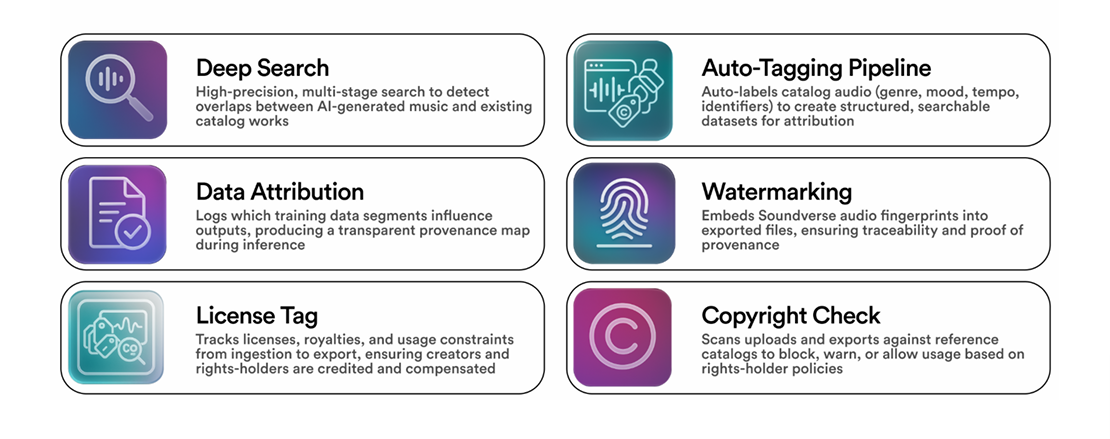
Soundverse Trace acts as a verifiable trust layer for AI music. It ensures every sound you create carries embedded attribution, traceable metadata, and licensing fingerprints from dataset to final export. When this information travels with the audio file, YouTube’s Content ID system can more accurately assess whether the upload is truly original or licensed.
Core Capabilities of Soundverse Trace
- Deep Search: Performs high-precision scanning (1:1 and 1:N) across massive music catalogs to detect potential overlaps before you even publish.
- Data Attribution: Logs which training data segments influenced a particular AI output, providing a forensic-level record of creative lineage.
- Audio Watermarking: Embeds inaudible, robust fingerprints into every track—identifying ownership even after compression or remixing.
- License Tagging: Preserves rights metadata throughout every stage, from dataset ingestion to final audio export.
With these layers, creators eliminate guesswork. If Content ID ever flags an AI song, Soundverse Trace’s embedded data provides verifiable evidence showing when, how, and by whom the track was generated. For a deeper dive, watch our guide on creating Deep House music or explore Soundverse music creation tutorials.
For producers using Soundverse’s ecosystem, these capabilities tie seamlessly into complementary modules like the Ethical AI Music Framework, which enforces transparent data usage, and the Content Partner Program, where rights-holders receive recurring royalties from AI-generated music.
How Does Soundverse Trace Support YouTube Monetization?
On YouTube, monetization depends on clear ownership. When AI music carries verifiable attribution data, the Content ID review becomes faster and more accurate. YouTube’s systems can recognize Soundverse fingerprints and skip lengthy manual reviews, enabling faster ad approval and reduced takedown disputes.
For channels looking to scale, this means:
- Fewer False Claims: Embedded fingerprints minimize accidental copyright flags.
- Protected Revenue Streams: License-tagged tracks ensure revenue goes to the proper owner during splits.
- Effortless Royalty Tracking: Attribution logs act as digital receipts for automated royalty payout systems.
This synergy between attribution technology and YouTube’s Content ID transforms what used to be a confusing review process into a predictable, transparent workflow.
How Did the AI Music and Copyright Landscape Evolve by 2026?
Between 2024 and 2025, YouTube dealt with several disputes over AI remixes and synthetic vocals imitating well-known artists. Following global conversations around ethical AI use, 2026 has seen the deployment of more cooperative licensing models, similar to those in Soundverse’s Content Partner Program. Rights-holders now often contribute recordings for AI model training and receive automated payouts each time derivative content is used.
Creators can read more in this Soundverse analysis of how AI-generated music is transforming the industry, which explores how AI is reshaping copyright laws and creative business models.
How Can Musicians Protect Themselves Against Unintended Copyright Infringement?
Musicians and producers working with AI tools should maintain digital records of dataset sources, prompts, and versioned outputs. Proper file metadata minimizes future disputes during the Content ID review process. Using a platform like Soundverse Trace offers automated logging, but creators can take additional steps:
- Avoid referencing copyrighted material directly in prompts.
- Use verified datasets obtained from licensed contributors.
- Embed fingerprints before publishing to protect authorship.
- Regularly audit Content ID claims for accuracy.
- Stay informed with resources like Soundverse’s AI music generator reviews.
These proactive measures help ensure your AI compositions survive YouTube’s automated scrutiny without loss of monetization.
Create Music That Stands Out with Soundverse AI
Generate unique, royalty-free tracks with precision using Soundverse AI’s text-to-music system. Perfect your sound, stay copyright-safe, and enhance your creative workflow in minutes.
Related Articles
- Enhancing YouTube Content with Royalty-Free and Copyright-Free Music Using Soundverse AI: Discover how to boost your YouTube videos with music that’s both creative and safe from copyright claims.
- Navigating the World of Royalty-Free and Copyright-Free Music Using Soundverse AI: Learn how royalty-free and copyright-free tracks can elevate your content without legal headaches.
- How AI-Generated Music Is Transforming the Music Industry: Explore how AI is revolutionizing music creation and pushing the boundaries of artistic innovation.
- Copyright-Free vs Royalty-Free Music: What Creators Should Know: Understand the key differences between copyright-free and royalty-free music to protect your creative work.
Here's how to make AI Music with Soundverse
Video Guide
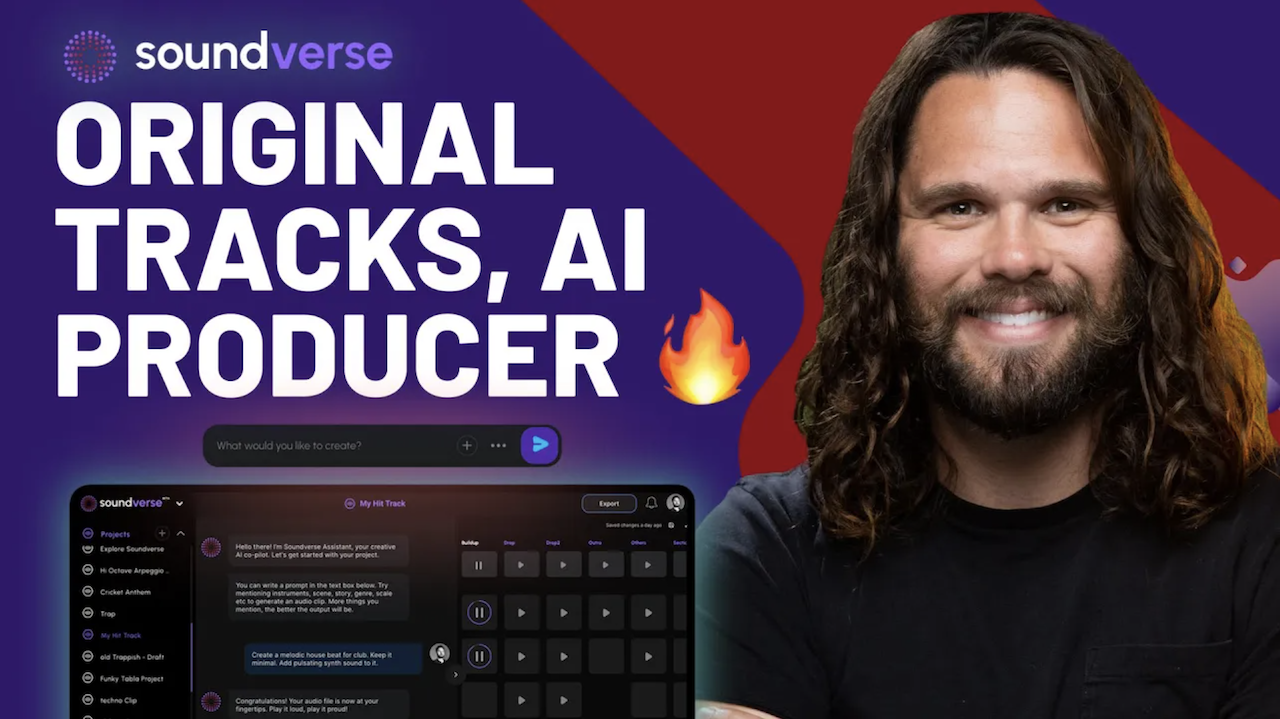
Here’s another long walkthrough of how to use Soundverse AI.
Text Guide
- To know more about AI Magic Tools, check here.
- To know more about Soundverse Assistant, check here.
- To know more about Arrangement Studio, check here.
Soundverse is an AI Assistant that allows content creators and music makers to create original content in a flash using Generative AI. With the help of Soundverse Assistant and AI Magic Tools, our users get an unfair advantage over other creators to create audio and music content quickly, easily and cheaply. Soundverse Assistant is your ultimate music companion. You simply speak to the assistant to get your stuff done. The more you speak to it, the more it starts understanding you and your goals. AI Magic Tools help convert your creative dreams into tangible music and audio. Use AI Magic Tools such as text to music, stem separation, or lyrics generation to realise your content dreams faster. Soundverse is here to take music production to the next level. We're not just a digital audio workstation (DAW) competing with Ableton or Logic, we're building a completely new paradigm of easy and conversational content creation.
TikTok: https://www.tiktok.com/@soundverse.ai
Twitter: https://twitter.com/soundverse_ai
Instagram: https://www.instagram.com/soundverse.ai
LinkedIn: https://www.linkedin.com/company/soundverseai
Youtube: https://www.youtube.com/@SoundverseAI
Facebook: https://www.facebook.com/profile.php?id=100095674445607
Join Soundverse for Free and make Viral AI Music

We are constantly building more product experiences. Keep checking our Blog to stay updated about them!
Image Steps: []