How AI Music Generators Work: The Technology Behind Generative Music
Discover how AI music generators create music using machine learning and neural models.
How AI Music Generators Work
Artificial intelligence has transformed music creation, empowering musicians and producers in 2026 to go beyond traditional composition. One of the most fascinating innovations in this space is the rise of AI music generators—systems capable of turning simple text prompts into full instrumental tracks. These tools combine machine learning, neural networks, and pattern recognition to create music that’s surprisingly human-like.
What is an AI Music Generator?
An AI music generator is a digital system that creates music automatically using artificial intelligence. Instead of relying on manual composition, users simply describe what they want—such as “an upbeat electronic background track”—and the AI produces an instrumental that fits that brief. Behind this simplicity lies a sophisticated network of algorithms trained on vast musical datasets.
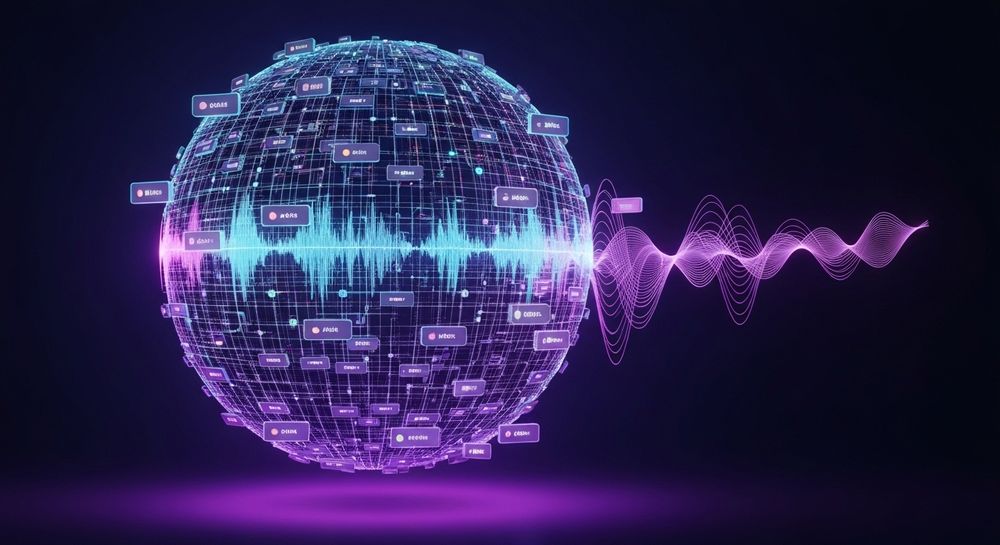
These models analyze melody, harmony, rhythm, tempo, and genre conventions. They don’t just copy songs; they infer relationships between musical elements to craft unique arrangements. Modern generators in 2026 have evolved far beyond early experiments seen in 2024, when AI music often felt rigid and repetitive.
According to Octopus Intelligence, an AI song generator is software that uses machine learning to compose music automatically, refining results dynamically based on context and prompt structure.
How Does Generative Music AI Work?
Generative music AI refers to systems that automatically produce new music rather than remixing existing content. They use deep learning, especially neural music models, to understand the structure of sound. The learning process typically includes three major components:
- Data Training: The AI studies thousands of licensed compositions. It learns how different genres sound—such as pop, jazz, ambient, or lo-fi—by analyzing note transitions, chord patterns, and instrument timbres.
- Feature Extraction: Neural networks break down each piece into mathematical representations (vectors) describing pitch, tone, and rhythm. This allows the AI to understand abstract musical “rules.”
- Generative Output: Once trained, the AI produces new tracks from prompts or constraints. This is where machine learning in music truly shines—where the system creatively balances predictability and surprise.
When a user gives a text prompt like “soft piano minimalist piece for meditation,” the model maps linguistic descriptions to musical parameters, resulting in coherent soundscapes. Similar to insights shared by Beatoven.ai, these algorithms analyze vast amounts of data to understand sound patterns across multiple music genres.
For a deeper dive, watch our Soundverse Tutorial Series - 9. How to Make Music, where we visualize how prompts become melody lines.
What Are Neural Music Models?
Neural music models are the backbone of AI music generation. They mimic how composers reason about music over time. Using architectures like recurrent neural networks (RNNs) and transformers, these models handle temporal patterns—understanding not only single notes but also how sequences develop emotionally.
Each note or beat has context. A neural model predicts what comes next based on what came before, similar to how language models generate coherent sentences. The latest generation of models in 2026 leverages attention-based mechanisms, improving understanding of complex song structures. See explanatory works like AI Music Generation Platforms 2026 for comparisons of different architectures powering generative systems.
What Role Does Machine Learning Play in AI Composition?
Machine learning fuels the creative capability of AI composition tools. The system learns without explicit programming—it discovers harmonic progression, rhythm patterns, and even stylistic signatures on its own. Earlier eras (2024–2025) showed AI could imitate. Today, it can improvise.
Modern music AIs employ reinforcement learning, rewarding themselves for compositions that score well on aesthetic metrics. This gives them a kind of artistic feedback loop. The result is more emotionally effective music, crucial for film scoring, game soundtracks, and meditation audio.
Machine learning also powers personalization. Generators now adapt to user preferences—producing consistent outputs in a chosen style or mood, helping broad creative industries generate music faster. For visual learners, check the Soundverse Tutorial Series - 10. Make Deep House Music.
What Are Common Applications of AI Music Generators in 2026?
AI music generators are now mainstream tools for creative professionals. Key applications include:
- Video Background Music: Content creators rely on generators for royalty-free soundtracks tailored to visuals.
- Game Soundtracks: Developers use generative loops that adapt dynamically to game states.
- Meditation and Wellness Tracks: The AI’s ability to maintain steady ambience through Loop Mode is ideal for relaxation audio.
- Advertising and Commercial Scoring: Brands request specific moods—energetic, cinematic, or calm—and receive polished tracks that suit marketing campaigns.
In fact, many creators turn to AI tools reviewed in articles like best AI music generator top picks and review or explore practical guides such as how-an-ai-music-generator-inspires-creative-fusion to understand how best to integrate AI tracks into production workflows.
What is Soundverse and How Does It Use AI for Music Generation?
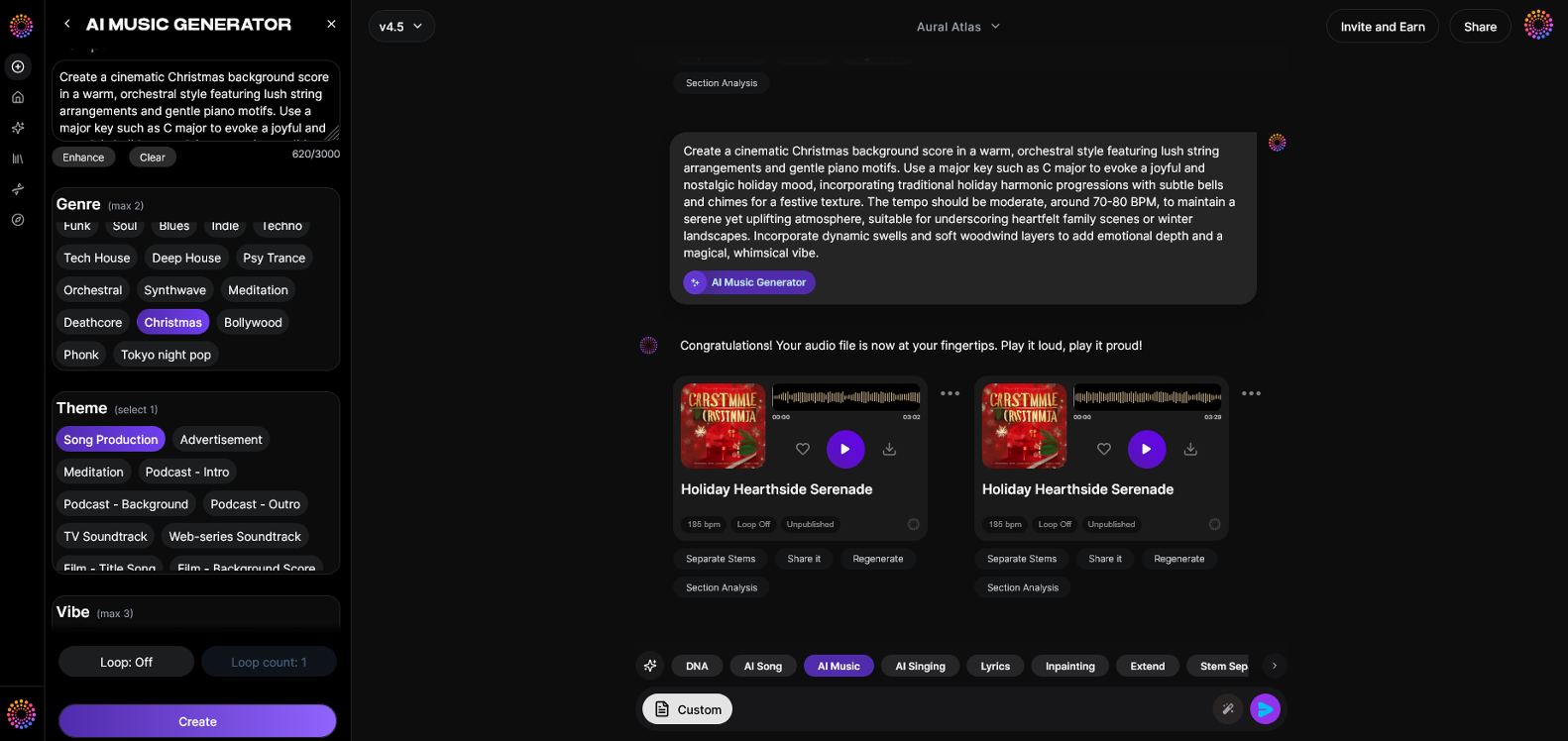
Now that you understand the core theory behind AI music generators, here’s how to create music instantly using Soundverse.
Soundverse’s AI Music Generator enables users to create fully produced instrumental tracks from text prompts. It focuses on instrumentals—background tracks, beats, and atmospheric soundscapes—without vocals. The system offers genre, mood, and instrument control, and features "Loop Mode" for seamless repetition. Users can select between advanced V4 and V5 models for different creative textures.
Core capabilities include
- Text-to-music generation: Converts written descriptions into custom instrumentals.
- Loop Mode: Allows smooth repetition for soundtracks or ambient sequences.
- Genre and mood precision: Choose emotional tone, rhythm intensity, and instrumentation.
- Model flexibility: Options between Soundverse V4 (fast production, broadly tonal) and V5 (fine-grained emotion modeling).
Primary use cases
- Video background music for YouTube and short-form content.
- Game soundtracks and adaptive looping.
- Meditation and wellness audio, where seamless loops are critical.
- Advertising and commercial scoring, giving brand managers instantly tailored music.
Soundverse also connects ethically to Soundverse DNA, ensuring that generation respects artists’ intellectual property by using licensed catalogs. Combined with the Ethical AI Music Framework, Soundverse provides transparency through consent, attribution, and artist compensation—solving one of the biggest challenges of generative AI music.
Those interested in specialized genres can explore related blogs such as How to Create Jazz Music with Soundverse AI or How to Create EDM with Soundverse AI.
For another visual exploration, visit the Soundverse Tutorial Series - 8. "Explore" Tab to discover how browsing and generation interfaces work.
Why Ethical AI Matters in Music Creation
With the expansion of generative tools, ethical questions have become critical. Unlike black-box algorithms, Soundverse maintains transparency. Its Ethical AI Music Framework ensures content integrity and fairness—artists whose work trains the models earn recurring compensation.
This distinction is vital in 2026, especially as debates continue about data privacy and ownership in creative computing. Responsible AI systems, like Soundverse, are pioneering fair technology in the music industry. For deeper insights, creators can read how-ai-generated-music-is-transforming-the-music-industry.
How to Make AI Music Instantly with Soundverse AI Music Generator
If you’re ready to try it yourself, Soundverse offers a streamlined workflow:
Step 1: Feature Overview
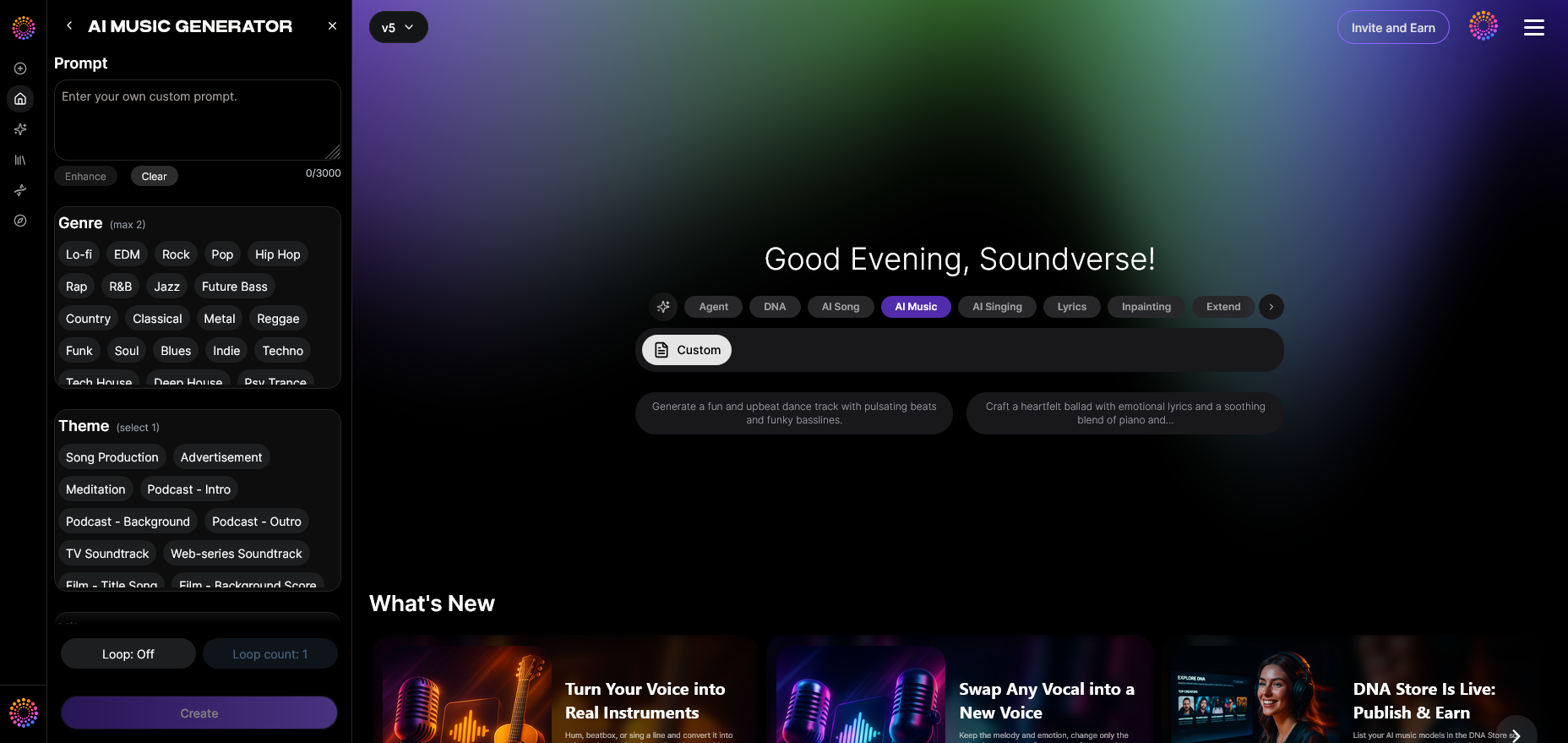
Access the AI Music Generator from the Soundverse main menu. It’s located within the “Create” section and handles instrumental generation.
Step 2: Description Input
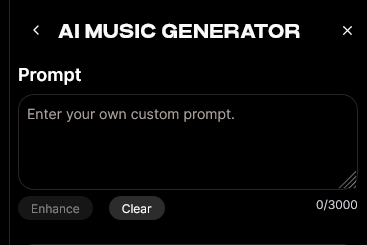
Enter a short text describing the track—such as “dreamy acoustic ambiance” or “dark cinematic synth score.” This prompt becomes the basis for all generation parameters.
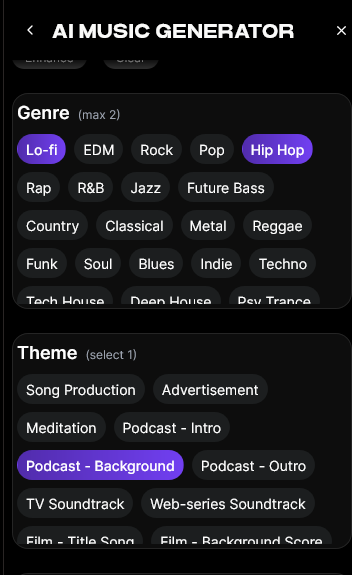
Step 3: Style & Duration
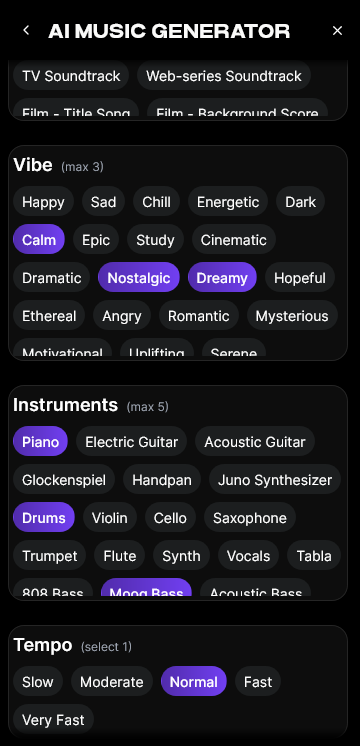
Select the music style (genre) and duration. Users can choose looped, short clips for gaming or longer segments for film.
Step 4: Generation
Click to generate instrumental music. The AI interprets your description and produces rich soundscapes using trained music models.
Step 5: Export Options

When satisfied, export the generated music in your chosen format for use in videos, games, or other production contexts.
For creators seeking custom control over sonic identity, Soundverse integrates seamlessly with Soundverse DNA, offering consistent sound generation linked to artist-specific profiles. This approach underscores a commitment to creative integrity while expanding musical diversity worldwide.
Final Thoughts
AI music generators have redefined music creation. In 2026, they serve not only as automated tools but also as collaborative partners for musicians and producers. With neural music models advancing and ethical infrastructures in place, creators can freely experiment while respecting artistic contributions.
Soundverse exemplifies this balance—bridging advanced technology with moral responsibility. Whether developing meditation tracks, composing for digital media, or scoring cinematic moments, Soundverse’s AI Music Generator stands as one of the leading solutions powering the new era of generative music production.
Start Creating Music with AI Today!
Unlock limitless creativity with Soundverse’s AI music generators. Instantly compose, mix, and customize tracks for any genre or vibe—no production experience required.
Try Soundverse Free
Related Articles
- The Benefits of Composing with AI Music Generator: Discover how AI composition tools streamline the creative process and inspire musicians to explore new sounds.
- How AI-Generated Music Is Transforming the Music Industry: See how AI music generators are reshaping production workflows, licensing, and creative collaboration in today’s music scene.
- AI Music Generator and Human Composers: A Future Together: Explore the evolving relationship between technology and artists in creating emotionally resonant music.
- Best AI Music Generator: Top Picks and Review: Compare the leading AI music generation platforms to find the perfect tool for your creative projects.
Here's how to make AI Music with Soundverse
Video Guide
Here’s another long walkthrough of how to use Soundverse AI.
Text Guide
- To know more about AI Magic Tools, check here.
- To know more about Soundverse Assistant, check here.
- To know more about Arrangement Studio, check here.
Soundverse is an AI Assistant that allows content creators and music makers to create original content in a flash using Generative AI.
With the help of Soundverse Assistant and AI Magic Tools, our users get an unfair advantage over other creators to create audio and music content quickly, easily and cheaply.
Soundverse Assistant is your ultimate music companion. You simply speak to the assistant to get your stuff done. The more you speak to it, the more it starts understanding you and your goals.
AI Magic Tools help convert your creative dreams into tangible music and audio. Use AI Magic Tools such as text to music, stem separation, or lyrics generation to realise your content dreams faster.
Soundverse is here to take music production to the next level. We're not just a digital audio workstation (DAW) competing with Ableton or Logic, we're building a completely new paradigm of easy and conversational content creation.
TikTok: https://www.tiktok.com/@soundverse.ai
Twitter: https://twitter.com/soundverse_ai
Instagram: https://www.instagram.com/soundverse.ai
LinkedIn: https://www.linkedin.com/company/soundverseai
Youtube: https://www.youtube.com/@SoundverseAI
Facebook: https://www.facebook.com/profile.php?id=100095674445607
Join Soundverse for Free and make Viral AI Music

We are constantly building more product experiences. Keep checking our Blog to stay updated about them!