Guaranteed Human vs AI Music: Industry Divide Explained
Explore the 2026 human vs AI music divide shaping the modern industry and how Soundverse bridges the gap ethically.
Guaranteed Human vs AI Music: Industry Divide Explained
The debate around human vs AI music has become one of the most defining conversations in the music industry of 2026. As artificial intelligence continues to evolve past the experimental phase seen in 2024 and the adoption surge of 2025, professionals are increasingly concerned with what this divide means for creativity, licensing, and industry standards. For artists, producers, and executives, understanding this split isn’t just academic—it impacts how music is created, monetized, and protected.
What does the human vs AI music divide look like in 2026?
The current landscape of the music industry split can be summarized as a crossroads between tradition and technology. On one side are human artists who emphasize emotion, experience, and artistic authenticity. On the other side, AI systems generate music using vast datasets, sometimes without clear consent or acknowledgment of the original creators.
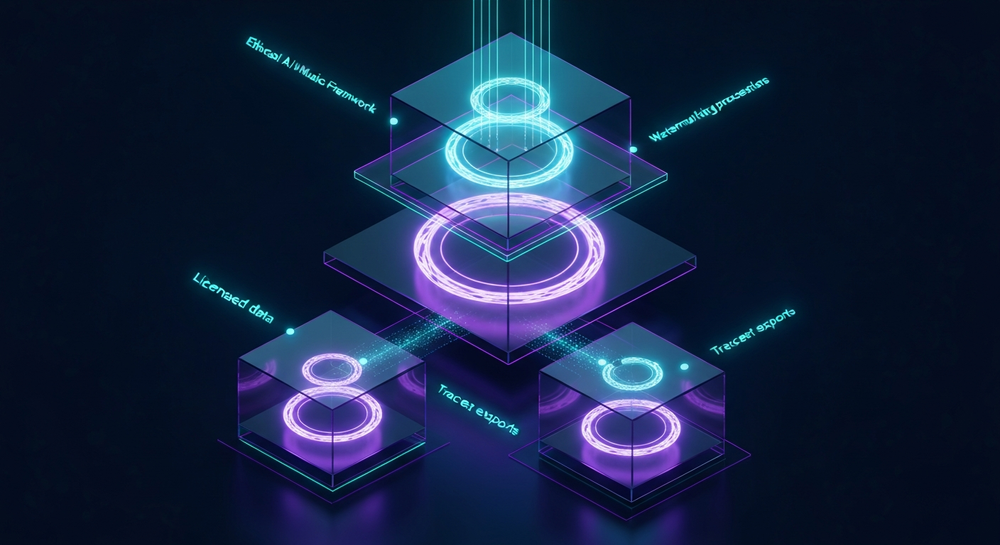
By 2026, the human vs AI songs debate has matured beyond novelty. In 2024, discussions focused on whether AI could capture emotional resonance. In 2025, the question evolved into licensing and data transparency. This year, the challenge is balancing innovation with accountability, making sure creativity remains ethically grounded in proper data use and attribution.
Modern music consumers have grown accustomed to discovering AI-assisted music on streaming platforms, yet some miss the imperfection and emotional nuance of human-created songs. Meanwhile, AI tracks dominate corporate campaigns, background scores, and social media content because of cost efficiency and speed. The music industry split is now less about capability and more about ethical sustainability. As noted by WNFM’s “AI's Mainstream Move: What Music Looks Like in 2026”, AI is already a structural component of production, crediting, and monetization.
Why is the human vs AI music debate intensifying?
The reason this conversation intensifies in 2026 is twofold: legality and value perception. Many producers, after witnessing the explosion of AI music platforms between 2024–2025, realized that opaque training models jeopardized artist integrity. Some AI systems scraped public datasets, creating tracks based on stolen sonic identities—a major cause for backlash.

At the same time, record labels recognized the potential profitability of AI-driven sound creation. Short-form media platforms prioritize speed and volume, and AI fulfills those demands seamlessly. Yet, when AI generation becomes detached from human creativity, industry trust erodes.
This tension led to stricter global oversight. Multiple regions now draft policies that require transparent model training and artist consent. Enterprises seek partnerships that guarantee compliance—creating space for frameworks like Soundverse’s Ethical AI Music Framework. According to VinylCulture's 2025 Review & 2026 Forecast, the generative AI music economy could swell to over $64 billion by 2028.
What does this divide mean for producers, artists, and labels?
Music producers in 2026 are redefining their workflow to coexist with AI. Instead of fighting automation, many integrate AI tools for composition assistance while retaining human oversight for emotion and direction. Artists consider AI a collaborator—not a competitor—but remain cautious about ownership rights. For a hands-on example, watch our tutorial on how to make music using Soundverse AI.
Record labels face a logistical decision: embrace AI generation under responsible frameworks or risk irrelevant business models by ignoring technological shifts. As the market demands faster releases, those who rely exclusively on human processes may struggle to meet digital timelines unless they pair sustainable AI systems.
For artists worried about losing identity, platforms such as Soundverse DNA prove critical. This artist-trained model safeguards creative DNA—letting musicians license their own sonic style to generate fresh, copyright-safe content. It turns identity protection into a monetization channel.
What ethical frameworks are supporting the new music era?
The notion of ethical AI music has entered mainstream industry discourse. Transparent architectures allow labels and creators to trace where data originated, how it was used, and how royalties flow back to contributors. This transparency marks the practical solution to the human vs AI music debate.
Industry leaders have realized that without a clear ethical ecosystem, human artistry risks being diluted. Thus, in 2026, ethical infrastructures like Soundverse Trace and Content Partner Programs empower rightsholder engagement. Through such systems, creators subscribe their audio data safely instead of having it scraped from the web. iMusician’s 2026 trend report confirms an industry-wide embrace of AI as a creative partner, marking an important cultural shift.
Ethical AI doesn’t only protect rights—it builds industry trust. By guaranteeing attribution and recurring compensation, platforms align technological progress with moral responsibility. This model creates a stable revenue structure even for smaller artists participating in AI training datasets.
How to make ethical progress in AI music generation?
As the music industry approaches full AI integration, ethical progress means adopting verified frameworks for transparency rather than relying on black-box generation. Technical safeguards such as watermarking, traceable exports, and explainable inference ensure auditability and prevent plagiarism.
Artists and producers exploring AI composition tools should understand how licensed data differs from public scraping. Licensed models recognize contributors, provide clear user terms, and compensate rightsholders when their data informs generated outcomes. This standardization protects both creators and businesses using AI-generated tracks.
For those new to AI composition, resources like “How AI-generated music is transforming the music industry” and “Navigating the world of royalty-free and copyright-free music using Soundverse AI” explain how regulatory compliance intersects creativity. The practical takeaway remains simple—ethical AI equals long-term sustainability. For a visual guide, check out our video on the “Explore” tab”.
How to make human vs AI music synergy with Soundverse’s Ethical AI Music Framework
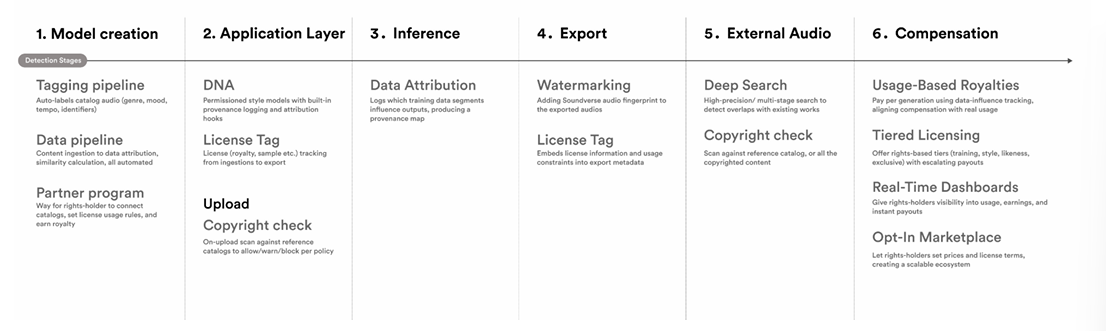
The ethical divide finds a structured solution through Soundverse’s Ethical AI Music Framework, designed to ensure consent, attribution, and recurring royalties while maintaining artistic authenticity. This six-stage transparent pipeline replaces hidden AI processes with traceable operations compliant with enterprise licensing standards.
Stage 1: Licensed Data Sourcing
Soundverse collects only legally obtained, licensed audio datasets. No scraping or unauthorized use occurs, guaranteeing artists’ work stays protected from exploitative collection.
Stage 2: Permissioned Models (DNA)
Each model incorporates the Soundverse DNA feature—artist-trained AI that captures authentic sonic identity while maintaining copyright safety. This mechanism prevents imitation or cloning without consent.
Stage 3: Explainable Inference (Attribution)
Whenever AI generates content, attribution is clearly documented. Users can trace how influence data contributed to the final track, embedding accountability throughout the process.
Stage 4: Traceable Export (Watermarking)
Generated audio embeds invisible watermark signatures allowing post-generation auditability. This security ensures rightful ownership is always verifiable by both creators and enterprise users.
Stage 5: Deep Search (External Scanning)
Soundverse Trace performs external scanning to confirm the originality of AI outputs against existing catalogs. It prevents accidental overlaps and supports fair distribution.
Stage 6: Recurring Compensation (Partner Program)
Finally, contributors earn continuing royalties through the Content Partner Program—a usage-based structure that pays creators whenever their licensed material helps generate new AI compositions.
Together, these stages form an end-to-end trust layer connecting innovation with artistic justice. Labels and creators leveraging the Ethical AI Music Framework effectively dissolve the divide between human creativity and AI technology.
What other tools strengthen ethical AI music creation?
Complementary Soundverse tools extend this ecosystem. Soundverse Trace embeds attribution across the entire life cycle of a track, from dataset formation to distribution. The Content Partner Program provides recurring compensation tied to usage metrics, establishing an equitable model for rightsholders.
Meanwhile, Soundverse DNA enables artists to monetize their personal style authentically. With proper permissioned training, the system produces copyright-safe tracks that reflect real human signatures—a practical merging of emotion and automation. These tools represent how AI can respect, rather than replace, human expression.
For additional insights on effective use of AI-tools, check “Soundverse AI Revolutionizing Music Creation for New Age Content Creators” and “AI Music Generator and Human Composers: A Future Together”. They illustrate how professional creators employ AI ethically while maintaining creative control.
Create Your Next Track with Soundverse AI
Experience cutting-edge AI music tools that empower creators to blend the best of human artistry and machine precision. Generate, remix, and customize music with intuitive features designed for all skill levels.
Related Articles:
- AI Music Generator and Human Composers: A Future Together — Discover how human creativity and AI technology can collaborate to shape the next era of music production.
- How AI-Generated Music is Transforming the Music Industry — Explore how AI-driven composition tools are redefining workflows, accessibility, and creativity in the music business.
- The Role of AI Music in Film and Television — Learn how AI music generation is reshaping content scoring and sound design for entertainment and streaming platforms.
- AI Music in the USA — Dive into how the United States is leading innovation and adoption in AI music production and policy.
Here's how to make AI Music with Soundverse
Video Guide
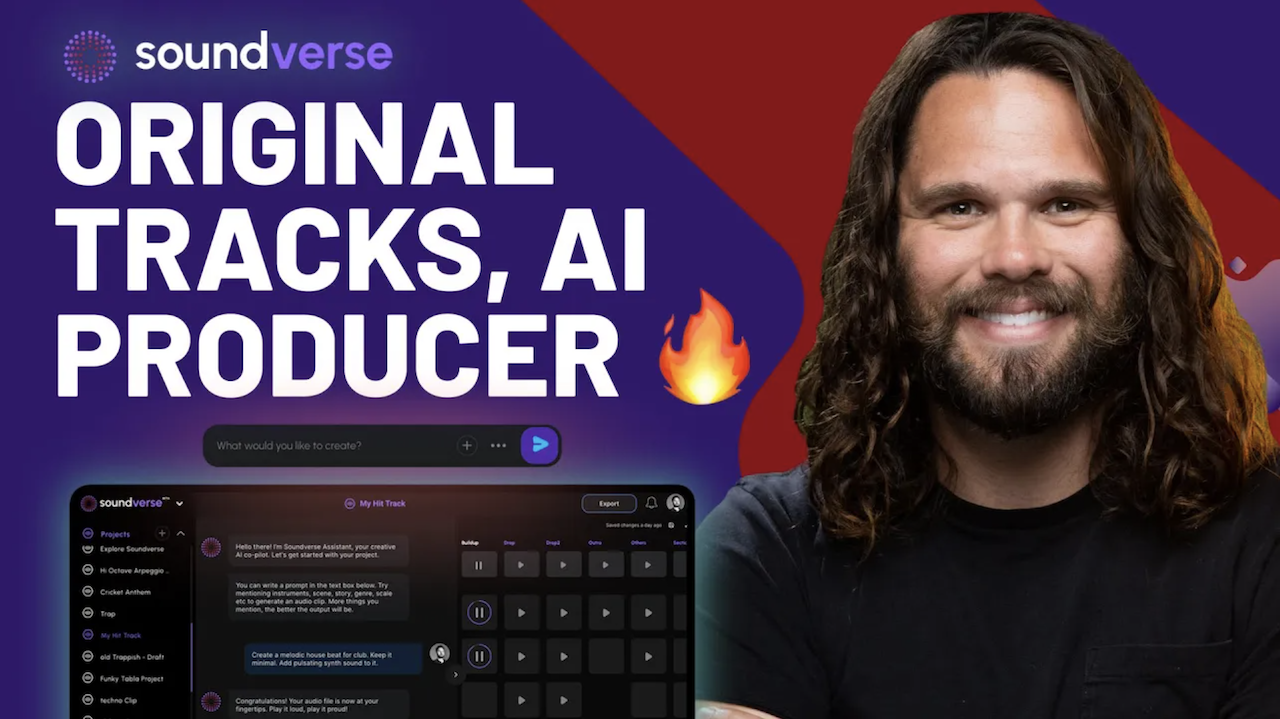
Here’s another long walkthrough of how to use Soundverse AI.
Text Guide
- To know more about AI Magic Tools, check here.
- To know more about Soundverse Assistant, check here.
- To know more about Arrangement Studio, check here.
Soundverse is an AI Assistant that allows content creators and music makers to create original content in a flash using Generative AI. With the help of Soundverse Assistant and AI Magic Tools, our users get an unfair advantage over other creators to create audio and music content quickly, easily and cheaply. Soundverse Assistant is your ultimate music companion. You simply speak to the assistant to get your stuff done. The more you speak to it, the more it starts understanding you and your goals. AI Magic Tools help convert your creative dreams into tangible music and audio. Use AI Magic Tools such as text to music, stem separation, or lyrics generation to realise your content dreams faster. Soundverse is here to take music production to the next level. We're not just a digital audio workstation (DAW) competing with Ableton or Logic, we're building a completely new paradigm of easy and conversational content creation.
TikTok: https://www.tiktok.com/@soundverse.ai
Twitter: https://twitter.com/soundverse_ai
Instagram: https://www.instagram.com/soundverse.ai
LinkedIn: https://www.linkedin.com/company/soundverseai
Youtube: https://www.youtube.com/@SoundverseAI
Facebook: https://www.facebook.com/profile.php?id=100095674445607
Join Soundverse for Free and make Viral AI Music

We are constantly building more product experiences. Keep checking our Blog to stay updated about them!