EU AI Act and Voice Cloning Regulations Explained
Learn how the 2026 EU AI Act shapes voice cloning, AI music, and digital identity protection across Europe.
EU AI Act and Voice Cloning Regulations Explained
In 2026, the European Union’s Artificial Intelligence Act (EU AI Act) has become the cornerstone of global AI governance, shaping not only how algorithms operate but also how creative and voice-based AI systems comply with ethical and legal standards. At the heart of the conversation lies a growing concern over voice cloning — the ability of AI systems to replicate or synthesize human voices that sound nearly indistinguishable from the original.
This article explores the EU AI Act voice cloning regulations, what they mean for developers, artists, and digital content creators, and how companies like Soundverse are helping enterprises achieve compliance while preserving innovation.
Why does the EU AI Act matter for voice cloning?
The EU AI Act, formally adopted in late 2025, categorizes AI applications into different risk levels ranging from minimal to unacceptable. Voice cloning sits in a particularly sensitive area because it affects biometric and identity attributes. Unlike simple text generation, synthetic voices can impersonate individuals, influence public discourse, and infringe intellectual property rights.
Under the 2026 legislative framework, any system capable of replicating or generating human voice likenesses now requires transparent data sourcing, explicit consent from the original speaker, and clear labeling of synthetic content. Developers must demonstrate explainability and traceability within their AI pipelines to avoid non-compliance penalties, as detailed in the EU AI Act compliance essentials for voice AI.

What are the new EU voice regulations in 2026?
European voice laws introduced through the AI Act specify three major obligations for voice technology providers:
- Consent for Data Usage: Any data used to train voice synthesis models must be licensed and sourced with documented permission. Scraping public audio from social platforms without consent now constitutes a regulatory offense, according to the EU voice cloning compliance guide.
- Transparency Obligations: AI-generated voices must be labeled as synthetic. Disclosures must appear both in metadata and user-facing interfaces.
- Attribution and Compensation: When an AI system generates music or voice outputs based on an identifiable performer, that performer must be credited and compensated through recurring royalty mechanisms.
Regulators view these rules as essential not only for protecting privacy but also for fostering fair creative ecosystems across Europe, marking the full enforcement timeline of the AI Act.

How are creators and developers adapting to AI voice regulations?
Developers and content producers are increasingly adopting compliance-first frameworks. Many AI studios have shifted from open scraping toward licensed datasets. Startups working in musical voice synthesis and podcast production are also implementing watermarking technologies that tie generated content back to authorized data sources.
In 2026, professional content creators in Europe expect AI music and voice solutions to adhere to ethical standards similar to those found in traditional entertainment licensing. This shift from opacity to traceability has led to an explosion of compliant creative workflows.
For context, platforms discussed in Soundverse’s blog such as Soundverse Assistant and Soundverse Trace demonstrate how transparent AI music tools work within regulated environments. These references reflect a broader industry transition toward ethical AI engineering. For a deeper dive, watch our guide on creating Deep House music.
How does the EU AI Act affect AI music and audio generation?
While the act primarily addresses risk management for high-impact AI systems, it extends directly into creative industries. For music generators and vocal synthesis tools, compliance involves clear provenance tracking. Every stage — from input data to final audio export — must be auditable.
The term “AI act music” now describes the integration of Europe’s regulatory principles into creative products. For labels and studios, it ensures digital identity protection while maintaining competitive innovation. For developers, this means redesigning AI pipelines to enable attribution and compensation for rights holders.
What is digital identity protection under the EU AI Act?
Digital identity, in the context of voice cloning, pertains to maintaining the authenticity and security of one’s vocal characteristics. The EU recognizes voiceprints as biometric identifiers, similar to facial or fingerprint data. Thus, unauthorized replication of someone’s voice legally equates to identity misuse.
Digital identity protection in the EU now mandates encryption of training assets, active watermarking of synthesized voices, and mandatory disclosure notifications when cloned voices are used commercially. Companies must allow audit trails ensuring users can trace how and where their vocal likeness appears.
These guidelines align closely with broader European data protection practices under GDPR, creating a unified foundation for ethical AI deployment across creative and communication platforms.
How to make compliant AI-generated voices under EU law
To create legally compliant AI-generated voices, organizations must adopt transparent frameworks that integrate consent tracking, licensed data sourcing, and post-generation attribution. Open models trained on internet audio lack the documentation required by EU standards. The lawful approach involves permission-based systems that validate every data contribution.
Enterprises are increasingly seeking solutions that provide auditable transparency. One of the leading examples is Soundverse, whose internal AI infrastructure aligns precisely with the EU’s 2026 voice standards.
How Soundverse The Ethical AI Music Framework enables EU AI Act compliance
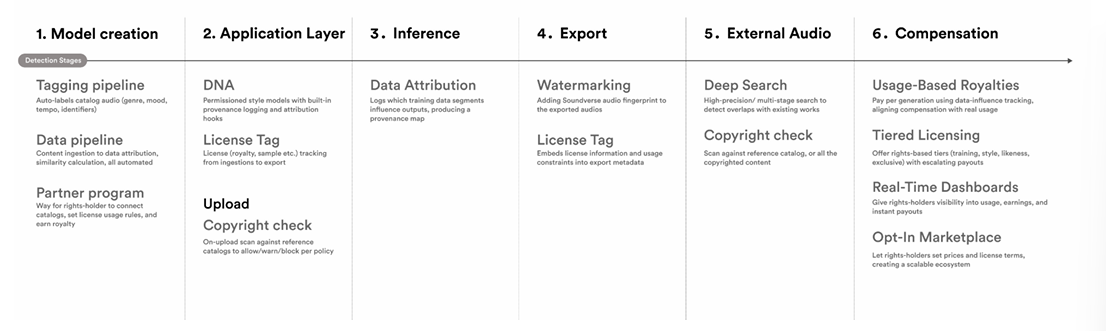
Soundverse’s Ethical AI Music Framework directly addresses each pillar of the EU AI Act voice cloning regulations. This end-to-end infrastructure bridges innovation with artist integrity through a transparent six-stage pipeline.
- Stage 1: Licensed Data Sourcing (No scraping) ensures that all voice and music input originates from legally authorized datasets, solving the consent problem.
- Stage 2: Permissioned Models (DNA) locks artist permissions into model architecture, enabling selective access per license.
- Stage 3: Explainable Inference (Attribution) provides a technical audit trail showing who contributed what influence in the generated output.
- Stage 4: Traceable Export (Watermarking) embeds identity markers in generated audio, preserving traceability beyond platform boundaries.
- Stage 5: Deep Search (External Scanning) allows independent systems to verify whether an exported track matches licensed materials elsewhere on the web.
- Stage 6: Recurring Compensation (Partner Program) converts model attribution into revenue for original contributors.
Through this framework, Soundverse offers an actionable mechanism for enterprises to implement EU AI Act compliance efficiently. It replaces black-box generation with explainable AI workflows that support ongoing regulatory certification.
For creators seeking balanced innovation and protection, Soundverse integrates legal soundness with creative freedom. It also works seamlessly with tools described in articles like Generate AI Music with Soundverse Text-to-Music and How to Create Jazz Music with Soundverse AI, showcasing compliant, high-quality outputs within AI governance frameworks. For additional tutorials, check our music creation guide.
The role of Soundverse Trace and Partner Program
Supporting the main framework, Soundverse Trace acts as a digital trust layer embedding watermarking and rights protection from dataset creation to export. This enables compliance validation for Europe’s evolving voice regulations. Meanwhile, the Content Partner Program provides recurring royalties to approved contributors, reflecting the EU’s emphasis on equitable compensation.
Together, these systems elevate AI generation from purely technical innovation to sustainable, ethically compliant artistry. You can also discover the Explore Tab walkthrough to see how voice and music compliance works hands-on.
What challenges remain for AI voice providers in Europe?
Even with strong frameworks, providers still face complex interoperability gaps. Cross-border licensing between EU states and global content platforms can be cumbersome. Moreover, smaller developers must adapt rapidly to documentation-heavy processes to avoid fines.
However, by 2026, regulators have begun introducing certification templates for low- and medium-risk applications, offering practical pathways for innovators. Voice and music creators benefit from these as they simplify consent verification and watermark auditing.
Firms staying informed through resources like Music Industry Trends can better anticipate technical obligations as regulations continue evolving.
Explore AI Music Creation with Soundverse
Turn your ideas into stunning AI-generated tracks that respect new EU AI Act voice cloning regulations. Create, remix, and produce music faster and smarter with Soundverse’s tools.
- How AI-Generated Music Is Transforming the Music Industry: Discover how AI innovation is reshaping musical creation and distribution across global industries.
- Navigating the World of Royalty-Free and Copyright-Free Music Using Soundverse AI: Learn how creators can safely use AI tools to generate original, rights-compliant music content.
- Soundverse AI Revolutionizing Music Creation for New Age Content Creators: Explore how Soundverse empowers creators with cutting-edge AI music generation technology.
- AI Music in the USA: Understand how different regulations and policies influence AI music and voice use across regions.
Here's how to make AI Music with Soundverse
Video Guide
Here’s another long walkthrough of how to use Soundverse AI.
Text Guide
- To know more about AI Magic Tools, check here.
- To know more about Soundverse Assistant, check here.
- To know more about Arrangement Studio, check here.
Soundverse is an AI Assistant that allows content creators and music makers to create original content in a flash using Generative AI.
With the help of Soundverse Assistant and AI Magic Tools, our users get an unfair advantage over other creators to create audio and music content quickly, easily and cheaply.
Soundverse Assistant is your ultimate music companion. You simply speak to the assistant to get your stuff done. The more you speak to it, the more it starts understanding you and your goals.
AI Magic Tools help convert your creative dreams into tangible music and audio. Use AI Magic Tools such as text to music, stem separation, or lyrics generation to realise your content dreams faster.
Soundverse is here to take music production to the next level. We're not just a digital audio workstation (DAW) competing with Ableton or Logic, we're building a completely new paradigm of easy and conversational content creation.
TikTok: https://www.tiktok.com/@soundverse.ai
Twitter: https://twitter.com/soundverse_ai
Instagram: https://www.instagram.com/soundverse.ai
LinkedIn: https://www.linkedin.com/company/soundverseai
Youtube: https://www.youtube.com/@SoundverseAI
Facebook: https://www.facebook.com/profile.php?id=100095674445607
Join Soundverse for Free and make Viral AI Music

We are constantly building more product experiences. Keep checking our Blog to stay updated about them!