Do AI Song Generators Keep Track of Every Song They Create?
Explore how AI song generators manage, log, and protect their musical outputs in 2026.
Do AI Song Generators Keep Track of Every Song They Create?
Artificial intelligence has rapidly become an integral part of the music industry, reshaping how artists, producers, and creators compose and produce songs. By 2026, AI song generators have evolved into essential tools that can turn words or prompts into fully-produced tracks featuring vocals, melodies, and arrangements. But as their creative capabilities continue to advance, one crucial question keeps surfacing among musicians and tech enthusiasts: do AI song generators keep track of every song they create?
What Are AI Song Generators and How Do They Work?
AI song generators are specialized systems that use machine learning models trained on extensive datasets of music. These datasets often include various genres, compositions, lyrical structures, and instrumentations. When a user provides input—such as lyrics, a mood description, or a genre—the AI interprets the prompt, generates musical elements, and outputs a song that matches the given criteria.
In this process, the model effectively draws from patterns it has learned. The generator doesn’t merely copy existing tracks; rather, it synthesizes new material based on the relationships between rhythm, harmony, instrumentation, and vocal characteristics. Modern platforms have integrated reinforcement learning and fine-tuned neural nets to ensure originality and diversity across outputs. As seen in resources such as Best AI Music Generators to Create Original Songs in 2026 and 25 Best AI Music Generation Apps 2026 | Rokform, these systems now handle multi-instrument arrangements, stem control, and even customized vocal production.
For hands-on exploration of AI composition workflows, watch our Soundverse Tutorial Series - How to Make Music.
Do AI Song Generators Log or Record Every Output?
The simple answer is: it depends on the design of the system. Some music AI tools store metadata, logs, or fingerprints of created songs to help track usage and prevent duplication. Others, particularly open-ended models, may not maintain a comprehensive registry of all outputs.
When musicians use text-to-song or audio-generation tools, the platform may record:
- The user query or prompt.
- The generated audio file and its unique identifiers.
- Metadata related to production settings (tempo, style, instruments).
- Internal generation seeds or checkpoints to reproduce results if necessary.
This data helps ensure transparency, protect intellectual property rights, and maintain user access to prior creations. However, widespread tracking varies from company to company, and ethical considerations remain central to how such systems operate.
Why Does Data Tracking Matter in AI Music Creation?
As AI-generated songs become increasingly prevalent in both personal projects and commercial releases, robust data tracking is more important than ever. Tracking establishes accountability—identifying which datasets were used and whether any copyrighted materials influenced the output.
In 2026, as licensing frameworks evolve and agencies regulate generative content more tightly, creators must ensure their work isn’t unintentionally violating copyright laws. Platforms that embed traceability within their systems provide added assurance to both users and rights holders.
Song generator data tracking enables:
- Verification of originality: Determining if the output replicates or overlaps with existing works.
- Royalty distribution: Ensuring rightful payment for samples, dataset sources, or shared compositions.
- Transparency for users: Allowing musicians to understand and cite the origins of their AI-assisted projects.
Without such mechanisms, the ecosystem might struggle to separate unique creations from copies, leading to disputes over ownership and consent.
How Machine Learning in Music Handles Attribution
Machine learning in music is trained using large corpora of sound data, annotated by genre, tempo, chord progression, or lyrical structure. By 2026, these systems operate less as opaque black boxes and more as controlled environments managed under ethical AI frameworks.
Attribution has become an integral step within AI music creation pipelines. Models are now integrated with layers capable of recording which training data influenced the output, providing insight into lineage and contribution. This traceability ensures that AI models can be audited and verifies which music fragments or creators indirectly shaped a generated song.
Tools that integrate data attribution mechanisms bring an unprecedented level of precision, allowing artists to create without fear of plagiarism or ownership disputes. Tracking technologies have also introduced watermarking and license metadata embedding—two essential features that enhance provenance verification and copyright oversight.
For additional context on studio workflows, explore our Soundverse Tutorial Series - "Explore" Tab and Soundverse Tutorial Series - Make Deep House Music.
Are There Privacy Risks in AI Generated Songs?
When discussing tracking systems, privacy naturally becomes a concern. Musicians and producers often ask whether their inputs—lyrics, stems, or vocal recordings—are stored indefinitely.
Ethical platforms anonymize and encrypt user inputs, separating creative data from identifiable information. The balance lies in preserving accountability while respecting user ownership. By 2026, most advanced music AI tools rely on decentralized or consent-driven data structures rather than global repositories of user uploads.
For professionals who value both innovation and privacy, the ability to opt out of certain forms of tracking or attribution remains key. This flexibility empowers creators to manage rights while maintaining transparency with collaborators.
What Makes Soundverse Trace a Game-Changer for Song Tracking?
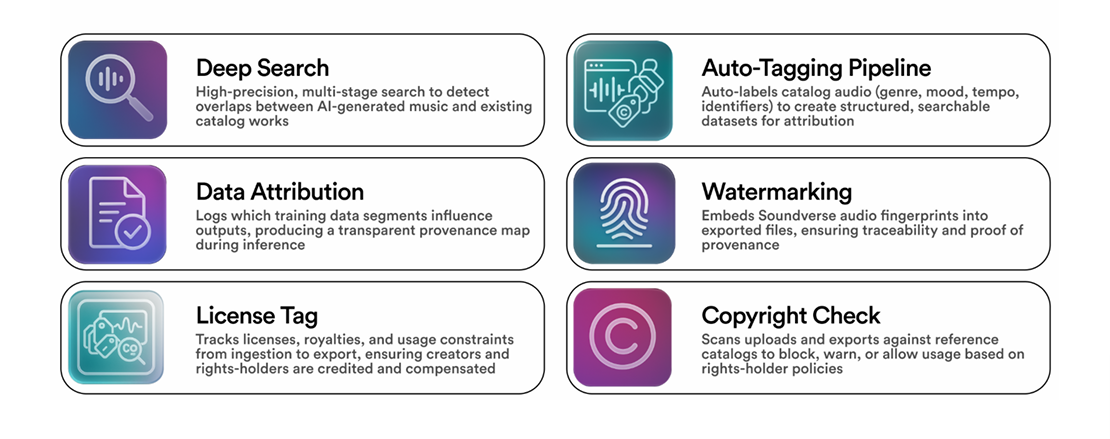
Now that you understand how data tracking functions across AI music systems, here’s how Soundverse enables complete oversight of the creative lifecycle.
Soundverse Trace – The Comprehensive Trust Layer for AI Music
Soundverse Trace is a trust layer designed to embed attribution, deep search, and rights protection throughout the entire AI music process—from dataset registration to final song export.
Its core capabilities include:
- Deep Search: High-precision scanning (1:1, 1:N) mechanisms that detect overlaps or similarities between generated tracks and existing cataloged materials.
- Data Attribution: Logs which training datasets influenced the AI model during creation, ensuring transparent authorship links.
- Audio Watermarking: Embeds inaudible fingerprints directly into the track, enabling perpetual traceability without altering sound quality.
- License Tagging: Preserves rights metadata at every stage, from dataset ingestion to song export.
The result is a transparent, resilient music creation environment that supports artists and rights holders equally.
Soundverse Trace plays a vital role within the Ethical AI Music Framework, ensuring every AI generated song aligns with consent-based artistry. Together, they form a system that bridges innovation and integrity—a universal standard for ethical AI music creation.
For musicians seeking advanced, transparent production workflows, Soundverse Trace ensures all generated outputs carry durable lineage and proof of ownership. This empowers users to prevent infringement, automate royalty payouts, and safeguard creative legacies.
Connecting AI Music Creation with Broader Industry Trends
This transformation aligns with broader innovations discussed in recent Soundverse articles, such as the evolution of AI music generation trends and deeper insights into copyright and royalty management. As seen in how AI-generated music is transforming the industry, sound tracking and attribution mechanisms are now recognized as foundational components of responsible AI composition.
Start Creating Music with AI Today!
Discover the power of Soundverse’s AI song generators to produce unique tracks in minutes. Bring your musical ideas to life effortlessly and redefine how you create sound.
Related Articles
- What AI Can Generate Songs
Explore how different AI systems create original songs and what makes each generator unique. - How AI-Generated Music Is Transforming the Music Industry
Dive into how AI-generated music is redefining creativity, production, and collaboration for artists worldwide. - The Benefits of Composing with AI Music Generator
Learn how AI music generators can inspire creativity and streamline your composition process. - AI Music Generator and Human Composers: A Future Together
Discover how human creativity and AI innovation can harmonize for the future of music composition.
Here's how to make AI Music with Soundverse
Video Guide
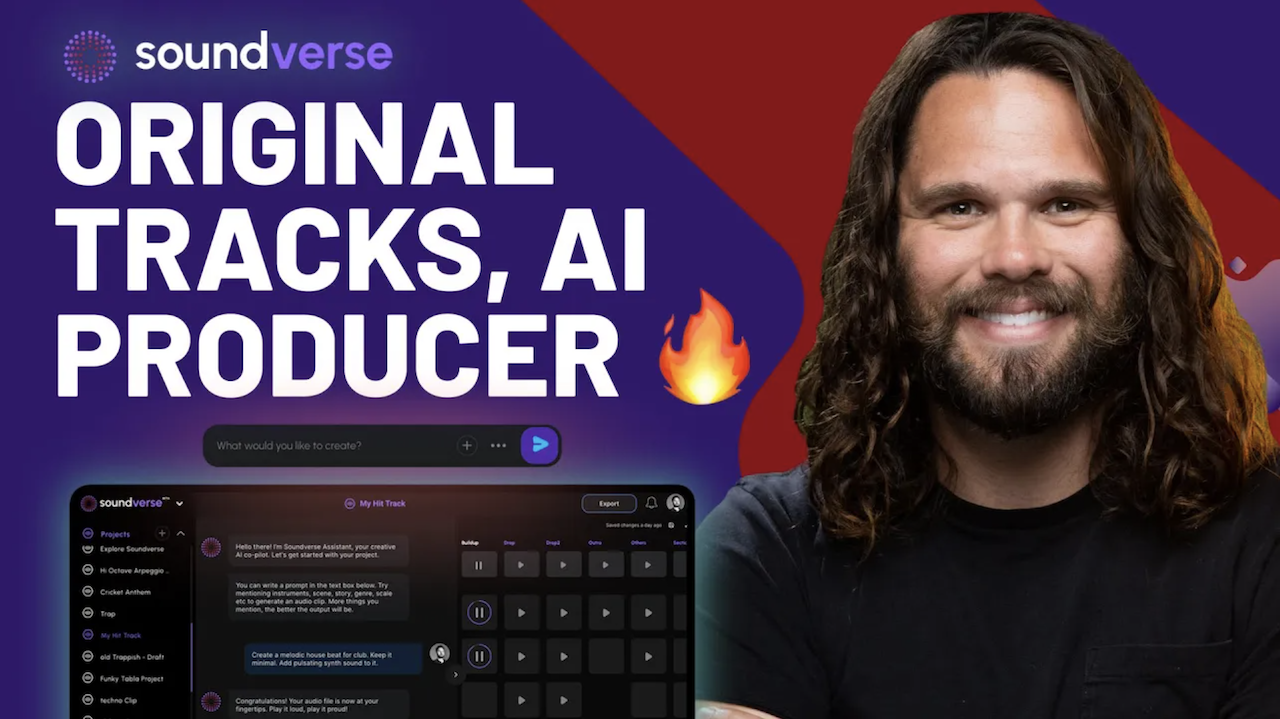
Here’s another long walkthrough of how to use Soundverse AI.
Text Guide
- To know more about AI Magic Tools, check here.
- To know more about Soundverse Assistant, check here.
- To know more about Arrangement Studio, check here.
Soundverse is an AI Assistant that allows content creators and music makers to create original content in a flash using Generative AI. With the help of Soundverse Assistant and AI Magic Tools, our users get an unfair advantage over other creators to create audio and music content quickly, easily and cheaply. Soundverse Assistant is your ultimate music companion. You simply speak to the assistant to get your stuff done. The more you speak to it, the more it starts understanding you and your goals. AI Magic Tools help convert your creative dreams into tangible music and audio. Use AI Magic Tools such as text to music, stem separation, or lyrics generation to realise your content dreams faster. Soundverse is here to take music production to the next level. We're not just a digital audio workstation (DAW) competing with Ableton or Logic, we're building a completely new paradigm of easy and conversational content creation.
TikTok: https://www.tiktok.com/@soundverse.ai
Twitter: https://twitter.com/soundverse_ai
Instagram: https://www.instagram.com/soundverse.ai
LinkedIn: https://www.linkedin.com/company/soundverseai
Youtube: https://www.youtube.com/@SoundverseAI
Facebook: https://www.facebook.com/profile.php?id=100095674445607
Join Soundverse for Free and make Viral AI Music

We are constantly building more product experiences. Keep checking our Blog to stay updated about them!
Image Steps: []