Celebrity Voice Cloning: What's Legal in 2026?
Explore celebrity voice cloning legal 2026 topics, rights, and AI voice ethics.
Celebrity Voice Cloning: What's Legal in 2026?
In 2026, the line between creativity and imitation in digital sound has never been thinner. The rise of artificial intelligence, especially in voice generation, has given rise to celebrity voice cloning—an innovation that lets creators reproduce the distinct vocal characteristics of famous people for entertainment, marketing, and user engagement. But with technological power comes legal complexity. So, what exactly makes celebrity voice cloning legal (or illegal) in 2026?
What is celebrity voice cloning?
Celebrity voice cloning refers to recreating a recognizable vocal identity using AI algorithms trained on voice samples. These systems analyze tone, pitch, rhythm, and delivery style to create synthetic speech that sounds indistinguishable from the source. Tools like Soundverse’s Voice Swap use community voice models and artist DNA to perform high-fidelity swaps while keeping the original emotion and timing of a recording intact.
Voice cloning exploded in mainstream culture around 2024–2025, when deepfake videos and synthetic voices gained traction on social media and in fan projects. By 2026, however, global regulations have become tighter, and digital likeness law—covering both voice and visual representation—has entered a more mature phase.
Why is celebrity voice cloning a legal issue in 2026?
Every voice carries identity, emotion, and commercial value. A celebrity’s voice, much like their face or name, is part of their brand—and therefore protected under various rights, including publicity rights and intellectual property laws. As the AI industry continued to evolve, unauthorized imitation raised questions about consent, defamation, and unfair commercial gain.

In 2026, several high-profile disputes have shaped the boundaries of acceptable use. Countries like the U.S. and U.K. extended their existing likeness protection laws to include synthetic voice generation. Meanwhile, the European Union enhanced its Digital Personality Act, making it illegal to reuse someone’s vocal likeness for commercial purposes without explicit consent. According to Synthetic Media & Voice Cloning: Right of Publicity Risks for 2026, AI voice cloning is forcing major updates in right-of-publicity law and talent licensing worldwide.
What laws govern celebrity voice cloning in 2026?
Legal standards now converge around three central frameworks:
- Right of Publicity: This restricts using someone’s identity—including their voice—for advertising or profit without permission.
- Copyright and Performance Rights: If the AI model generates new content that incorporates elements of protected speech or performances, it can trigger copyright claims, as noted in New York Court Tackles the Legality of AI Voice Cloning | Insights.
- Synthetic Media Disclosure Laws: Several jurisdictions, including California and South Korea, require creators to disclose when AI-generated voices are used, ensuring transparency to audiences.
Together, these frameworks set the foundation for how celebrity voice cloning is authenticated and distributed. Under 2026’s voice rights regulations, creators must seek explicit permission before reproducing, remixing, or selling voice-based products that sound like recognizable individuals.
What are voice rights in 2026?
“Voice rights 2026” has become a global term defining the collection of protections surrounding vocal identity. For public figures, voice rights encompass moral, commercial, and creative dimensions. Moral rights demand respect for reputation—preventing uses that distort or mock their voice without context. Commercial rights allow monetization through approved licensing models. Creative rights allow collaboration with AI platforms that share revenue or control data access.
Tools such as Soundverse’s Ethical AI Music Framework bridge innovation and integrity by ensuring consent-driven creation. The framework replaces opaque data training pipelines with transparent stages focused on consent, attribution, and recurring compensation.
Is AI celebrity voice use entirely banned?
Not necessarily. Under viral remix culture and parody exceptions, creators can still use celebrity-themed content within limits. Parody and satire remain protected under fair use in many countries, as long as they are clearly transformative and noncommercial.
An independent creator might, for instance, use a celebrity-style AI voice for humorous commentary in a non-profit podcast or video art piece. In these cases, context and disclosure determine legality. If an AI celebrity voice is presented clearly as synthetic and used for comment, promotion is permitted. However, monetization or deceptive impersonation crosses into infringement territory.
For a deeper dive into how Soundverse empowers creative production, check out our Soundverse Tutorial Series – “Explore” Tab and other voice creation guides on the Soundverse YouTube channel.
How do digital likeness rights apply to voices?
Digital likeness rights in 2026 extend beyond images. They recognize the voice as biometric data—a component of human identity that can’t be replicated without authorization. Many celebrity contracts now explicitly include digital likeness clauses that cover both virtual avatars and AI-rendered vocals.
Under these expanded rights, AI developers are required to register voice model datasets, disclose training sources, and display licensing agreements. Platforms like Soundverse Trace introduce deep attribution layers to verify where a voice model originated, whether it was trained ethically, and which usage rights accompany the output. This transparency ensures compliance while safeguarding creators and artists from misuse.
What are the key ethical challenges facing voice cloning today?
The ethical tension lies between creative freedom and personal privacy. On one hand, voice cloning democratizes content production, enabling fan projects, historical recreations, and multilingual performances without logistical barriers. On the other hand, misuse risks identity theft, misinformation, and reputational damage.
To mitigate these issues, creators and developers must adhere to consent-driven workflows. AI developers are now expected to balance innovation with protection—avoiding datasets that secretly contain unlicensed celebrity voices. Soundverse’s infrastructure ensures every model integrates licensed DNA so that both artists and creators benefit from ethical collaboration.
How to make celebrity voice cloning legal 2026 content with Soundverse Voice Swap
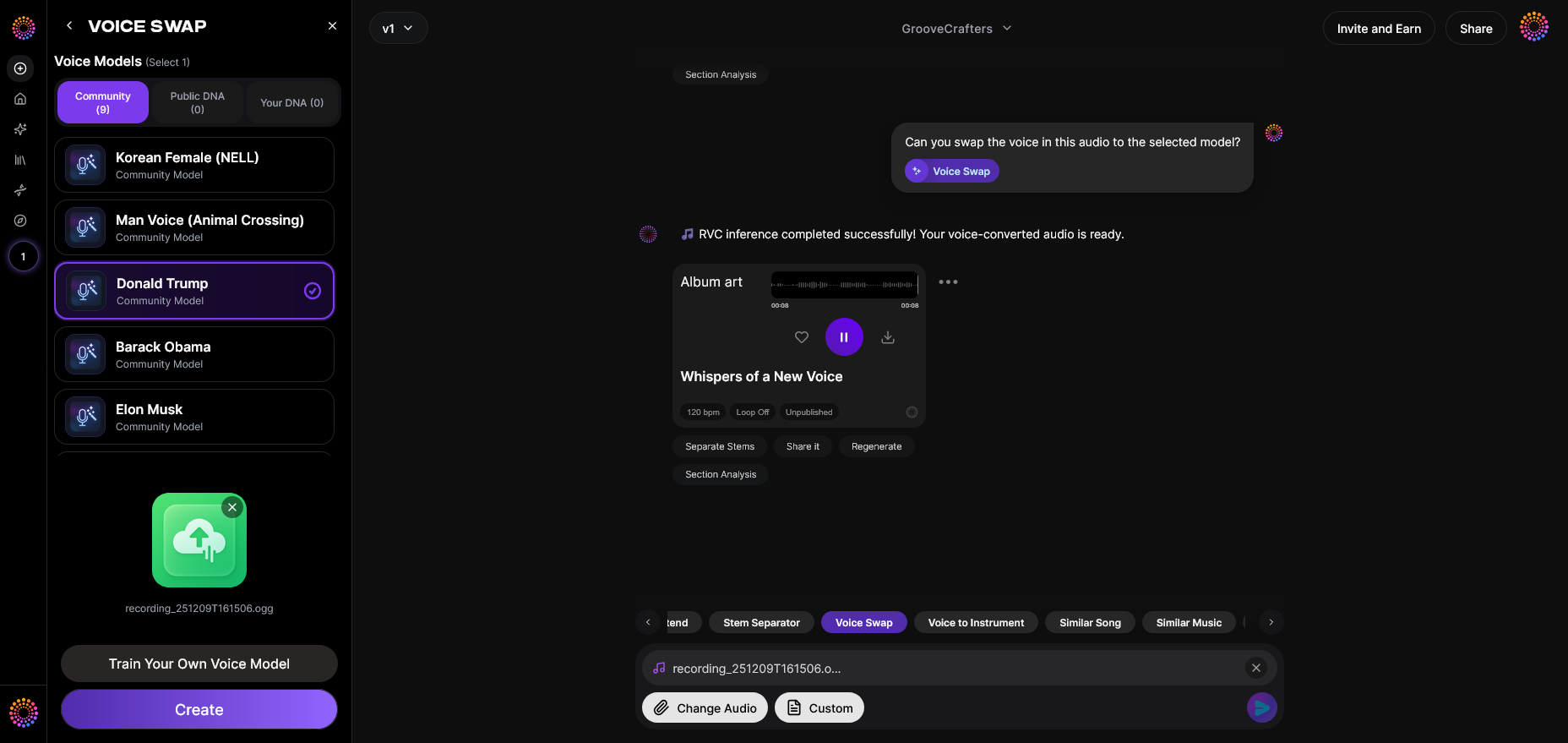
Soundverse Voice Swap empowers ethical voice cloning by using community-approved voice models, licensed datasets, and transparent pipeline validation. It replaces the vocal identity in any audio track while preserving timing, tone, and emotional expression. The Voice Swap workflow supports Community Voices, Public DNA, and Personal DNA, letting users create guide vocals, character voices for games and animation, or parody content without infringing copyrights.
Creators upload an existing vocal recording, choose their target voice model, and generate AI-transformed audio asynchronously (not live). This guarantees precision while respecting rights, since the system operates within Soundverse’s Ethical AI Music Framework. Safe creative experimentation—whether testing celebrity-inspired tones or designing fictional personas—is now possible without breaching any legal boundaries.
For developers interested in branching into voice-based storytelling or virtual entertainment, Soundverse integrates seamlessly with AI music generation workflows and stem separation tools to enhance production quality. These features allow flexible control over the entire sound domain while maintaining voice integrity and legal compliance.
How can creators stay compliant with cloning laws?
In 2026, the best practices include:
- Always obtain consent. Even when training an AI voice on small datasets, explicit agreement from the owner ensures safety.
- Disclose synthetic use. Add disclaimers when publishing AI creations with celebrity-style vocals.
- Avoid deception or misrepresentation. Don’t use cloned voices to impersonate real people for transactions, political statements, or fraud.
- Use licensed systems. Opt for tools such as Soundverse that integrate rights verification via Soundverse Trace.
- Stay informed. Voice cloning regulations evolve, and reading resources like music industry trend reports helps creators navigate updates.
What does the future hold for celebrity voice cloning?
By late 2026, experts predict deeper integration of consent frameworks within global AI infrastructure. Artists are leaning toward monetized licensing schemes that let fans transform voices ethically—turning potential infringement into participatory creativity.
Technically, voice cloning now moves toward identity-preserving synthesis: AI systems that simulate voices without pulling directly from real performers, instead generating stylistic imitations based on synthetic DNA rather than celebrity datasets.
Platforms like Soundverse sit at this frontier, building an ecosystem where synthetic creativity aligns with ethical transparency. By managing consent, attribution, and recurring compensation, technology finally respects personal and professional boundaries.
Explore AI Music Creation Legally and Confidently
Join Soundverse today to create professional-quality tracks, explore AI-generated voices, and stay compliant with the latest 2026 regulations around celebrity voice cloning.
- AI Music in the USA – Discover how U.S. laws are adapting to the rise of AI music and what it means for digital creators.
- Copyright-Free vs. Royalty-Free Music: What Creators Should Know – Learn the crucial difference between copyright-free and royalty-free music to ensure your AI projects are legally safe.
- Navigating the World of Royalty-Free and Copyright-Free Music Using Soundverse AI – A guide on how Soundverse helps you generate and use music that respects copyright boundaries.
- The Role of AI Music in Film and Television – Explore how AI-generated music is reshaping soundtracks and licensing for entertainment creators.
Here's how to make AI Music with Soundverse
Video Guide
Here’s another long walkthrough of how to use Soundverse AI.
Text Guide
- To know more about AI Magic Tools, check here.
- To know more about Soundverse Assistant, check here.
- To know more about Arrangement Studio, check here.
Soundverse is an AI Assistant that allows content creators and music makers to create original content in a flash using Generative AI. With the help of Soundverse Assistant and AI Magic Tools, our users get an unfair advantage over other creators to create audio and music content quickly, easily and cheaply. Soundverse Assistant is your ultimate music companion. You simply speak to the assistant to get your stuff done. The more you speak to it, the more it starts understanding you and your goals. AI Magic Tools help convert your creative dreams into tangible music and audio. Use AI Magic Tools such as text to music, stem separation, or lyrics generation to realise your content dreams faster. Soundverse is here to take music production to the next level. We're not just a digital audio workstation (DAW) competing with Ableton or Logic, we're building a completely new paradigm of easy and conversational content creation.
TikTok: https://www.tiktok.com/@soundverse.ai
Twitter: https://twitter.com/soundverse_ai
Instagram: https://www.instagram.com/soundverse.ai
LinkedIn: https://www.linkedin.com/company/soundverseai
Youtube: https://www.youtube.com/@SoundverseAI
Facebook: https://www.facebook.com/profile.php?id=100095674445607
Join Soundverse for Free and make Viral AI Music
We are constantly building more product experiences. Keep checking our Blog to stay updated about them!