AI Music Generators vs Human Producers: Who Owns the Future of Sound?
Explore the 2026 debate between AI Music Generators and human producers shaping the future of sound.
AI Music Generators vs Human Producers: Who Owns the Future of Sound?
In 2026, the music industry stands at a pivotal intersection — the collision between algorithmic innovation and human artistry. Artificial intelligence is no longer an experimental curiosity within studios; it has become a fully integrated collaborator. The rise of the AI Music Generator tools has triggered profound questions: Who owns the creative process? Who defines musical authenticity? And, ultimately, who will shape the future of sound?
What is driving the AI songwriting debate in 2026?
The AI songwriting debate exploded in popularity throughout 2024 and 2025 as tools that could generate music from text prompts gained mainstream adoption. By 2026, the discussion has evolved beyond simple experimentation. Now, professionals and enthusiasts are exploring the philosophical and ethical aspects of artificial intelligence in creativity.
AI systems can now write instrumental tracks that emulate jazz improvisations or atmospheric lo-fi sequences with remarkable precision. However, the core tension remains: music has always been a deeply human expression of emotion, imperfection, and cultural experience. Machines, while technically adept, analyze patterns rather than feelings. The challenge in 2026 is not whether AI can generate music but how artists and producers can co-create with these new digital collaborators without losing musical depth or identity.
How does AI in music production change creative workflows?
AI’s impact on music production is transformative rather than replacement. Human producers increasingly use AI in music production to accelerate workflows — from arrangement ideas to instant instrumental generation. AI tools like Soundverse’s AI Music Generator help creators skip the technical barriers, enabling them to describe their vision through words and instantly receive fully produced instrumentals.
This symbiosis allows producers to focus on melody, emotion, and performance while delegating sound design and background track generation to AI systems. The result is more time for creative refinement and less fatigue from repetitive tasks.
Key workflow changes observed by 2026 include:
- Faster ideation cycles – Musicians use text prompts to instantly audition moods or genres.
- Expanded genre exploration – With AI capable of creating reggae, ambient, cinematic, or trap beats on demand, producers experiment across boundaries.
- Ethical dataset integration – Modern tools trained with licensed catalogs prevent piracy and ensure artist royalties.
- Loop-based composition – AI-generated loops reduce the need for manual programming.
Are human music producers becoming obsolete?
The short answer is no. Despite advancements in velocity and complexity, human music producers remain irreplaceable when it comes to emotion-driven storytelling and musical cohesion. AI lacks subjective experience — it cannot feel heartbreak, nostalgia, or triumph. It interprets data points extracted from music examples rather than experiencing them.
Instead, AI serves as a sophisticated co-producer. It can mirror the producer’s intention but not originate human sentiment. Many professionals in 2026 use AI as a foundational layer — a script assistant rather than a director. The best tracks born from this collaboration integrate the algorithmic efficiency of AI with the emotional nuance of human intuition.
For a deeper dive, watch our guide on creating Deep House music or explore how to make music from text in the Soundverse Tutorial Series.
Music remains a reflection of personal identity, and while AI tools may generate highly competent sonic textures, they rely on artists for storytelling, structure, and interpretation. The future seems less about competition and more about creative convergence.
Why is ethical AI music development vital for the industry's sustainability?
The surge of generative systems raised significant concerns about artist consent and content ownership in 2024 and 2025. The unregulated data scraping practices of early AI models caused resistance among established musicians. By 2026, much of the music community now emphasizes transparency and attribution, making ethical AI design non-negotiable.
Platforms like Soundverse DNA, supported by the Ethical AI Music Framework, exemplify this progress. They ensure that music generation respects the contributing artist’s rights and provides recurring compensation. This evolution safeguards creativity while encouraging collaboration between AI engineers and musicians.
Without these ethical frameworks, AI-driven innovation risks undermining the very creativity it seeks to enhance. The goal is not infinite production but sustainable creation.
What benefits do producers gain from AI integration in 2026?
- Efficiency and scalability: AI reduces production time from hours to minutes, perfect for commercial composers and video creators who need constant output.
- Creative discovery: Algorithms can suggest unexpected arrangements or genre blends, inspiring producers to experiment beyond their comfort zone.
- Accessibility: Emerging artists can now produce professional-quality background tracks without expensive hardware.
- Consistency: Modern models offer repeatable sonic identities, making branding easier for influencers and content creators.
When paired with ethical datasets and artist-trained frameworks such as Soundverse DNA, producers can enjoy limitless experimentation without ethical compromise.
How do AI Music Generators work?
An AI Music Generator is not just a randomizer or preset tool; it’s a text-to-music engine that interprets language and builds full musical compositions. Unlike older loop libraries or MIDI-based systems, this generator uses natural language prompts (like “calm ambient synth with ocean textures”) to translate descriptive emotion into structured output.
These systems analyze lexical cues — tempo, genre, instrumentation, and emotion — and map them to digital signal clusters. The AI then produces an instrumental track aligned with the stated intent. Soundverse’s V4 and V5 Models have refined this process into accurate genre control and seamless looping for professional utility.
What does the future of AI and human collaboration look like?
By 2026, music creation no longer exists in isolation. Artists use AI to generate base compositions, and then they remix, add vocals, and manipulate stems manually. This fusion between human creativity and machine precision fosters hybrid artistry. AI becomes an invisible assistant embedded in daily musical workflows, similar to how digital audio workstations revolutionized sound engineering decades ago.
In the next few years, expect deeper integration of predictive compositional algorithms, adaptive style analysis, and cross-platform creative sharing, where artists teach AI their signature sound. You can see this trend mirrored in recent innovations discussed in Soundverse introduces stem separation AI Magic Tool and AI music transformation for content creators.
These collaborations produce personalized results instead of generic outputs — a true evolution toward identity-driven AI artistry.
How to make AI-driven instrumentals with Soundverse AI Music Generator
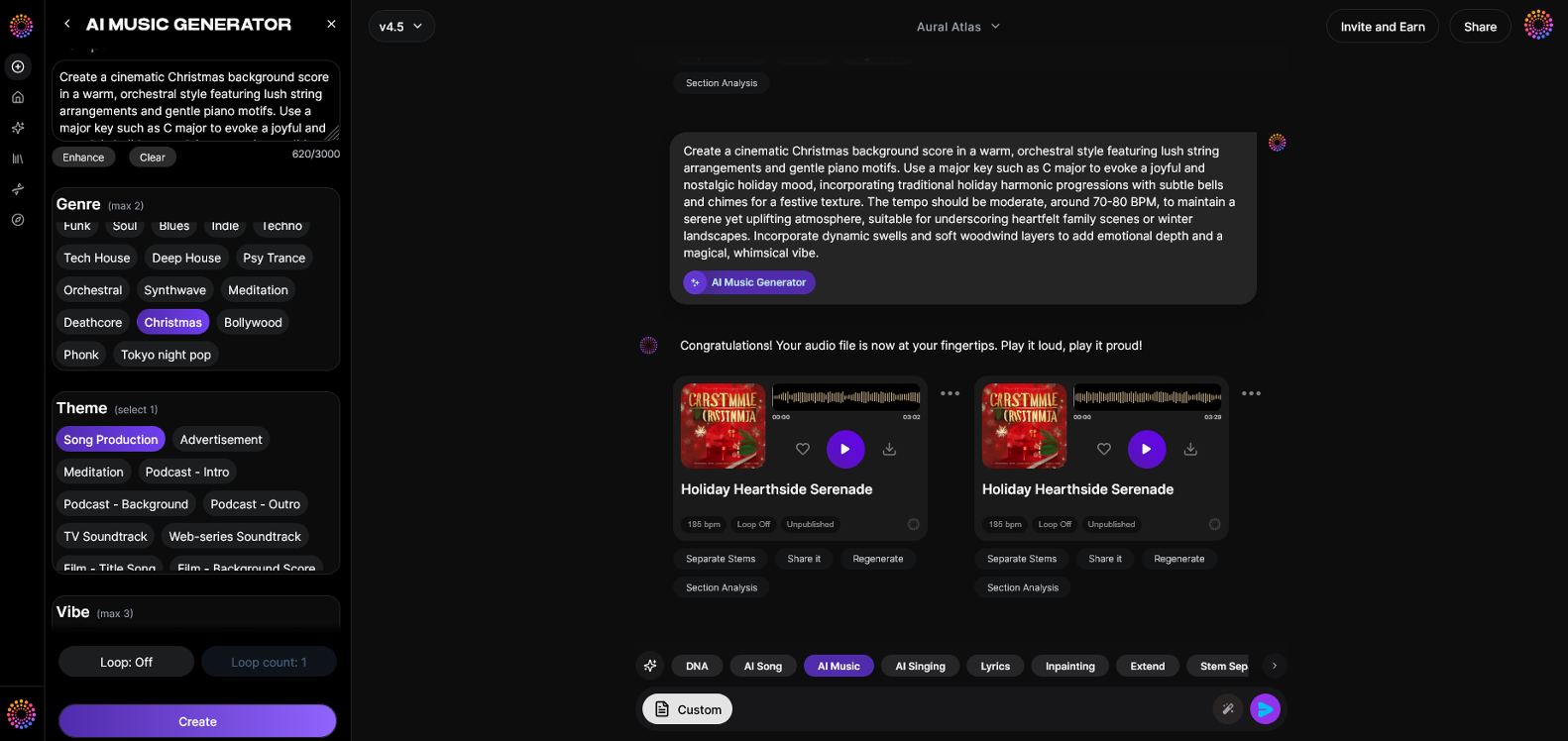
Now that you understand the contrast between human producers and AI systems, here is how to create instrumentals instantly using Soundverse AI Music Generator.
Soundverse’s AI Music Generator allows users to create fully produced instrumental tracks from text prompts. It specializes in background music, beats, and soundscapes without vocals. With Loop Mode, musicians can generate seamless repetitions for gaming, meditation, and advertising applications. Detailed genre, mood, and instrument controls make customization fast and contextually rich.
Soundverse offers two model options — V4 and V5 — enabling professionals to choose between stylistic precision or exploration-focused diversity. Whether composing for a film, a video, or podcast intros, users can instantly produce royalty-free, copyright-safe tracks within seconds.
Use Cases:
- Video Background Music: Perfect for YouTube creators, commercial editors, and videographers.
- Game Soundtracks and Loops: AI-generated loops help developers generate immersive sound environments.
- Meditation and Wellness Tracks: Seamless ambient textures support focus or serenity applications.
- Advertising and Commercial Scoring: Quick turnaround times for campaigns and product videos.
To explore more AI creation techniques and genre-specific workflows, visit How to Create Country Music with Soundverse AI, Best AI Music Generator: Top Picks and Review, and AI Music Generator and Human Composers: A Future Together.
Create Your Next Track with Soundverse AI
Experience the power of the leading AI Music Generator and compose high-quality, royalty-free music in minutes. Take your creativity to the next level with intelligent sound generation.
Related Articles
- The Benefits of Composing with AI Music Generator: Discover how an AI Music Generator can boost inspiration and streamline your music creation process.
- AI Music Generator and Human Composers: A Future Together: Explore how AI and human creativity can collaborate to create groundbreaking new soundscapes.
- How an AI Music Generator Inspires Creative Fusion: Learn how AI-driven tools are inspiring diverse musical fusion between genres and styles.
- How AI-Generated Music Is Transforming the Music Industry: See the ways AI technology is innovating music creation, distribution, and monetization across the industry.
Here's how to make AI Music with Soundverse
Video Guide
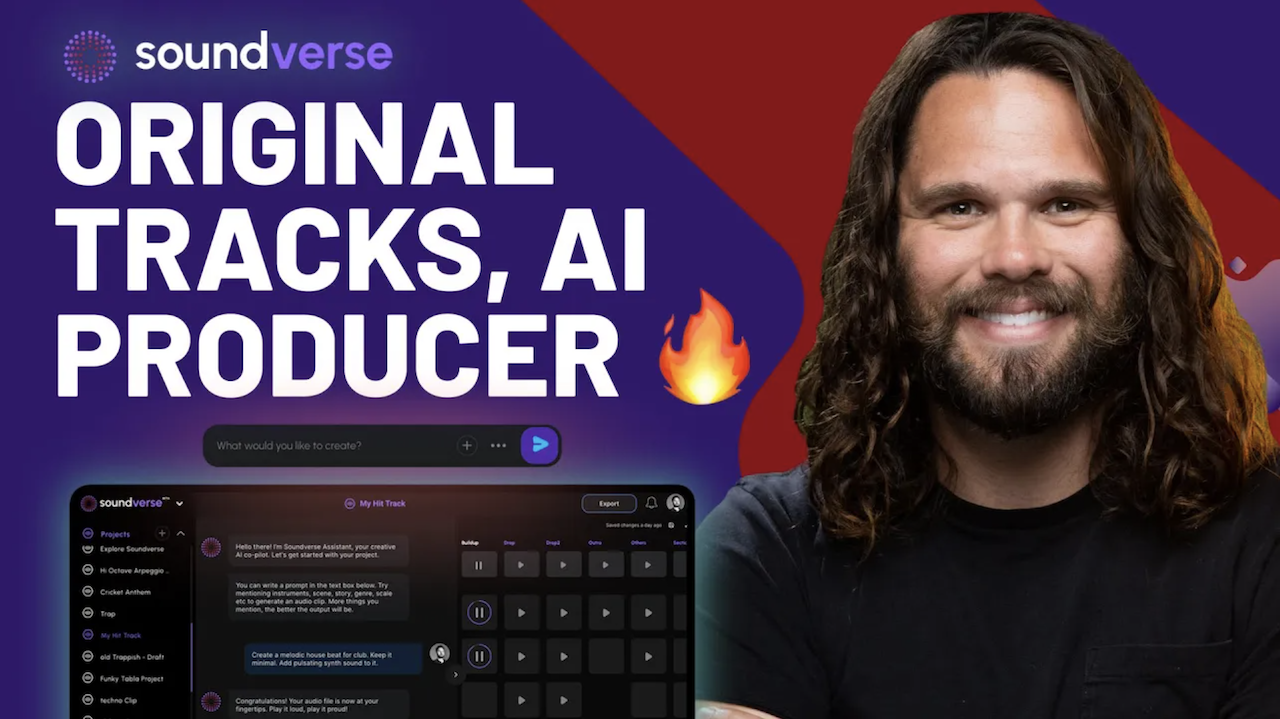
Here’s another long walkthrough of how to use Soundverse AI.
Text Guide
- To know more about AI Magic Tools, check here.
- To know more about Soundverse Assistant, check here.
- To know more about Arrangement Studio, check here.
Soundverse is an AI Assistant that allows content creators and music makers to create original content in a flash using Generative AI.
With the help of Soundverse Assistant and AI Magic Tools, our users get an unfair advantage over other creators to create audio and music content quickly, easily and cheaply.
Soundverse Assistant is your ultimate music companion. You simply speak to the assistant to get your stuff done. The more you speak to it, the more it starts understanding you and your goals.
AI Magic Tools help convert your creative dreams into tangible music and audio. Use AI Magic Tools such as text to music, stem separation, or lyrics generation to realise your content dreams faster.
Soundverse is here to take music production to the next level. We're not just a digital audio workstation (DAW) competing with Ableton or Logic, we're building a completely new paradigm of easy and conversational content creation.
TikTok: https://www.tiktok.com/@soundverse.ai Twitter: https://twitter.com/soundverse_ai Instagram: https://www.instagram.com/soundverse.ai LinkedIn: https://www.linkedin.com/company/soundverseai Youtube: https://www.youtube.com/@SoundverseAI Facebook: https://www.facebook.com/profile.php?id=100095674445607
Join Soundverse for Free and make Viral AI Music

We are constantly building more product experiences. Keep checking our Blog to stay updated about them!