AI Music Detection: False Positives & Appeals in 2026
Learn how AI music detection manages false positives and appeals with Soundverse Trace.
AI Music Detection: False Positives & Appeals
Artificial intelligence has transformed nearly every layer of music creation and distribution by 2026. From automated composition to instant copyright analysis, music creators and rights professionals now rely on AI-driven systems for integrity and scale. However, as with all technology, accuracy isn’t perfect. One of the newest challenges in this space is managing false positives—instances where AI music detection tools mistakenly flag original or licensed tracks as infringing content. This article explores how these misflags occur, what creators can do about them, and how Soundverse Trace helps bring balance to the ecosystem.
What is AI music detection and why is it critical in 2026?
AI music detection refers to software and machine learning models that analyze audio for patterns of similarity, copyright infringement, or synthetic generation. These tools are essential because AI-generated music now accounts for an estimated 35% of all new digital sound uploads, a figure that has doubled since 2024. Detection systems protect both creators and listeners by verifying provenance—making sure listeners know if a track is original, AI-assisted, or trained on existing works.

For platforms like YouTube, SoundCloud, and TikTok Music, detection algorithms help automate takedowns and payout systems. But the pressure for speed can lead to wrongful flagging, where genuine content by an independent artist gets classified as “AI mimicry” or “unauthorized use.” AI music detection tools are transforming how we create and identify musical works amidst rising concerns about authenticity in art.
Why do false positives happen in AI music detection?
False positives in AI music detection occur due to a combination of technical and contextual limitations:
- Dataset overlap: Many AI models share similar training sets sourced from public domain or licensed libraries. When detection systems compare outputs from different models, overlapping datasets can trigger a false match.
- Over-sensitive matching: Music detection algorithms often perform 1:N similarity comparisons, scanning a track against millions of references. Minor harmonic coincidences or rhythmic similarities can be mistakenly interpreted as duplication.
- Lack of attribution metadata: When audio files lack embedded rights data or watermarking, algorithms must rely on pattern recognition alone, which introduces uncertainty.
- Complex arrangements in modern AI compositions: Modern hybrid compositions—where human-musicians collaborate with AI tools—blur the boundaries between inspiration and duplication, confusing detection systems.

This growing complexity highlights why accurate attribution and provenance trails are becoming critical parts of music content moderation. AI music detectors use sophisticated machine learning algorithms to analyse audio fingerprints, spectral features, and temporal patterns within music files.
What happens when your music is wrongfully flagged?
When a detection system identifies overlap, it usually initiates one of three platform-level actions:
- Temporary takedown or demonetization: The track may be paused for review, restricting visibility or revenue.
- Automated copyright claim submission: Rights holders of the matched content can be automatically notified.
- Creator notification for appeal: Most major platforms provide portals for contesting the results.
For an individual creator, receiving a wrongful flag can be devastating—especially when algorithmic moderation delays exposure or monetization. In some cases, disputes can take weeks or months to resolve depending on the complexity of the evidence. For a deeper dive, watch our guide on creating Deep House music and our tutorial on how to make music with Soundverse AI to see how metadata-based tagging helps in prevention.
How can creators appeal false positives effectively?
Appealing a wrongful AI music detection result requires structured documentation and verification:
- Provide detailed metadata: Attach session files, project timestamps, and embedded watermark evidence to clarify ownership.
- Reference AI tool history: If the music was generated using transparent frameworks like the Ethical AI Music Framework, reference consent and attribution logs.
- Use traceable AI systems: Platforms that log dataset origins and influence weights make your case far stronger during appeals.
Most rights arbitration portals now allow audio fingerprint evidence submission, where creators can show embedded provenance data demonstrating originality.
Why do AI moderation systems sometimes struggle with complex licensing?
Music content moderation has grown exponentially since 2024, but in 2026, issues of hybrid licensing—where creative works involve mixed rights, reused stems, or shared credit—complicate detection systems. AI models often do not recognize nuanced contractual permissions baked into audio metadata. As a result, even legally licensed usage can get misinterpreted.
Cross-platform rights management teams increasingly integrate advanced copyright detection tools to reduce errors. Companies adopting structured frameworks for AI training—akin to the Soundverse Content Partner Program—report fewer false positives because their datasets maintain consistent attribution from ingestion to export.
How Soundverse Trace addresses the issue of AI music detection
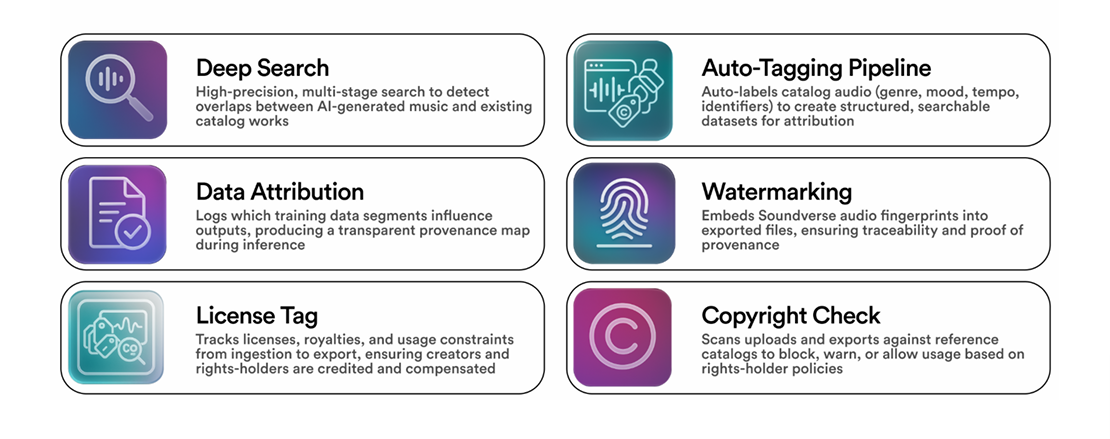
Soundverse Trace is a comprehensive trust layer for AI music that embeds attribution, deep search, and rights protection throughout a track’s lifecycle—from dataset generation to final export. Its key capabilities include:
- Deep Search: High-precision scanning (1:1 or 1:N) to identify overlaps accurately, mitigating wrongful flagging.
- Data Attribution: Logs which training data influenced the AI output so rights-holders have verifiable reference chains.
- Audio Watermarking: Embeds robust, inaudible fingerprints to help platforms instantly verify provenance.
- License Tagging: Preserves rights metadata from the beginning of ingestion to end-of-export.
By combining these layers, Soundverse Trace creates a transparent audit trail that dramatically reduces false positives. When integrated into moderation pipelines, content reviewers can quickly validate whether flagged tracks are truly infringing or simply similar. AI music detection tools help maintain the integrity of the music industry by verifying the origins of tracks and protecting the rights of artists.
How to make AI music detection more reliable with Soundverse Trace
The Soundverse Trace feature isn’t a real-time monitor. Instead, users upload or record audio, which the system processes asynchronously. Once processed, creators receive detailed reports outlining attribution graphs, similarity confidence scores, and metadata verification results.
The integration of Trace with the broader Ethical AI Music Framework ensures transparency from model creation to royalty payouts. Through the Content Partner Program, rights-holders also maintain active participation in dataset development for fair compensation.
When disputes arise, Soundverse Trace’s logged attribution paths simplify appeals because creators can show verifiable proof of independent origin. This audit capability is why many music professionals now adopt Trace within production workflows alongside AI composition tools such as Soundverse Arrangement Studio. For additional exploration, watch our “Explore” tab tutorial to understand how creators can manage attribution within Soundverse.
What does the future of AI music detection look like beyond 2026?
Looking beyond 2026, the next phase of AI music detection will focus on contextual intelligence—systems able to distinguish stylistic similarity from plagiarism based on source transparency. Regulators in both the EU and the US are encouraging open dataset declarations and watermarking mandates for all AI-generated music. Soundverse’s existing fingerprinting and license-tagging infrastructure aligns seamlessly with these policy directions.
The industry push for ethical AI frameworks, combined with attribution-based royalty automation, may soon eliminate the bulk of wrongful flagging. Many creators already use traceable tools when generating music for content in genres like EDM or Country, ensuring each composition carries transparent lineage metadata. As adoption expands, disputes between AI platforms and artists will diminish greatly.
Create and Test Your Own AI Music Today
Generate copyright-free tracks, explore genres, and see how Soundverse helps you stay ahead of AI music detection systems. Experience creative freedom without limits.
Start Creating Now
Related Articles
- How AI-Generated Music Is Transforming the Music Industry — Discover how AI composition tools are redefining creativity and pushing traditional boundaries within the music business.
- Navigating the World of Royalty-Free and Copyright-Free Music Using Soundverse AI — Learn how to create and use music safely in your projects by understanding copyright-free and royalty-free licensing with Soundverse.
- AI Music Generator and Human Composers: A Future Together — Explore the synergy between AI music generators and human artists, and what collaboration looks like for the industry’s future.
- Enhancing YouTube Content with Royalty-Free and Copyright-Free Music Using Soundverse AI — Find out how creators can use AI-generated, royalty-free tracks to elevate video content and avoid copyright issues.
Here's how to make AI Music with Soundverse
Video Guide
Here’s another long walkthrough of how to use Soundverse AI.
Text Guide
- To know more about AI Magic Tools, check here.
- To know more about Soundverse Assistant, check here.
- To know more about Arrangement Studio, check here.
Soundverse is an AI Assistant that allows content creators and music makers to create original content in a flash using Generative AI. With the help of Soundverse Assistant and AI Magic Tools, our users get an unfair advantage over other creators to create audio and music content quickly, easily and cheaply. Soundverse Assistant is your ultimate music companion. You simply speak to the assistant to get your stuff done. The more you speak to it, the more it starts understanding you and your goals. AI Magic Tools help convert your creative dreams into tangible music and audio. Use AI Magic Tools such as text to music, stem separation, or lyrics generation to realise your content dreams faster. Soundverse is here to take music production to the next level. We're not just a digital audio workstation (DAW) competing with Ableton or Logic, we're building a completely new paradigm of easy and conversational content creation.
TikTok: https://www.tiktok.com/@soundverse.ai
Twitter: https://twitter.com/soundverse_ai
Instagram: https://www.instagram.com/soundverse.ai
LinkedIn: https://www.linkedin.com/company/soundverseai
Youtube: https://www.youtube.com/@SoundverseAI
Facebook: https://www.facebook.com/profile.php?id=100095674445607
Join Soundverse for Free and make Viral AI Music

We are constantly building more product experiences. Keep checking our Blog to stay updated about them!