AI Music and Creative Authenticity: Finding the Balance in 2026
Explore how AI music reshapes creative authenticity and artistic voice in 2026.
AI Music and Creative Authenticity
Artificial intelligence has redefined sound design and composition, but the rise of AI music in 2026 has placed creators at a crossroads: How do we leverage machine creativity without losing our artistic soul? Musicians, producers, and digital artists are now exploring tools that promise efficiency while preserving emotional depth and creative authenticity.
What does AI music mean for creative authenticity in 2026?
AI music, once a technological experiment in automated sound generation, has evolved into a fully integrated part of music production technology. Modern models can compose entire symphonies or produce ready-to-mix tracks that mimic genre-specific dynamics. Yet, with this evolution, the central debate continues — how do artists maintain a unique artistic voice when machines can emulate most musical patterns?

In 2024 and 2025, generative systems offered accessibility but lacked transparency. Many relied on scraped datasets or unlicensed material, resulting in ethical controversies about ownership, likeness, and originality. By contrast, 2026 has witnessed a shift towards frameworks that prioritize consent, attribution, and sustainable monetization.
The relationship between creators and AI has grown more collaborative. Instead of threatening authenticity, properly governed AI models now provide new ways for musicians to express identity and emotion. The question has shifted from “Is machine creativity authentic?” to “How can we use AI to amplify authenticity?”
How is machine creativity changing the landscape of music production?
Machine creativity is no longer a novelty; it’s a professional asset. Producers use AI to craft signature textures, song structures, and adaptive soundscapes based on datasets sourced ethically from participating artists. The core appeal lies in the combination of precision and possibility.
Advanced music production technology allows AI to process user input and produce outputs that mirror creative intent. However, unlike human artistry rooted in emotion and experience, AI draws from computational logic. This gap between emotion and automation drives the ongoing discourse on human vs AI artistry.
Creativity now looks more like hybrid collaboration. A human artist might sketch an emotional chord progression, while an AI suggests harmonization techniques based on licensed archives. Together, they produce something that feels both modern and deeply personal. This synthesis represents a new form of co-creation, where authenticity isn’t lost but rather redistributed across human intuition and digital intelligence. For a deeper dive, watch our guide on creating Deep House music or how to make music using Soundverse tools.
What are the ethical challenges of AI music today?
The first wave of AI music tools presented three major ethical problems: consent, attribution, and compensation. Some tools scraped music from streaming platforms to train systems without proper permission. Others created works that sounded similar to well-known artists, sparking debates about creative plagiarism, as discussed in AI transforms the music industry - Liberty University.
By 2026, industry leaders recognized the need for transparency-first frameworks. Artists demanded systems that respected their intellectual property rights and rewarded contribution fairly. As AI becomes more embedded in professional workflows, musicians no longer accept opaque generation processes.
This demand has led to the emergence of structured frameworks focused on ethical governance. The most advanced platforms embed traceability mechanisms that reveal which sonic signatures influence an AI track. Others link AI-generated works to a royalty network ensuring recurring payments to original creators.
These measures represent an important shift: from unchecked automation to responsible innovation. They also affirm the belief that AI should empower, not replace, genuine artistic voices.
How can musicians preserve artistic voice while using AI?
Preserving an authentic sound begins with intention. Artists must decide how much control they wish to cede to AI systems. Here are several emerging practices shaping 2026’s creative workflows:
- Use AI as a collaborator, not a replacement. Tools can suggest harmonies, rhythms, or melodies, but final composition decisions should remain guided by artistic emotion.
- Train with licensed data. Partner with ethical platforms that honor original creators. Systems like Soundverse DNA allow artists to license their catalogs for AI training safely.
- Review attribution metadata. Transparency layers ensure artists know what influences drive each composition. This step helps protect integrity in collaborations.
- Monetize through ethical networks. Initiatives like the Content Partner Program generate royalties based on usage and attribution, offering sustainable income streams.
These practices reinforce a future where authenticity expands through ethical collaboration rather than dilution. For a full walkthrough of using these features, check out our “Explore” Tab video guide.
How are creators redefining authenticity in the era of AI music?
Authenticity in 2026 no longer means isolation from technology. Instead, it’s about integration with self-awareness. Artists trained to adapt can incorporate AI as a new instrument, similar to the historical introduction of synthesizers or digital workstations.
Listeners, too, now recognize this fusion. They no longer ask if a track was written by a machine but whether it makes them feel something real. AI music can evoke emotion as long as human intent drives the narrative. For example, producers who blend AI composition tools with personal storytelling continue to dominate streaming platforms.
In many cases, AI functions as creative infrastructure rather than a ghostwriter. It offers efficiency in composition, but human musicians still shape meaning and energy — the two building blocks of emotional resonance.
How to make ethical and authentic AI music with Soundverse The Ethical AI Music Framework
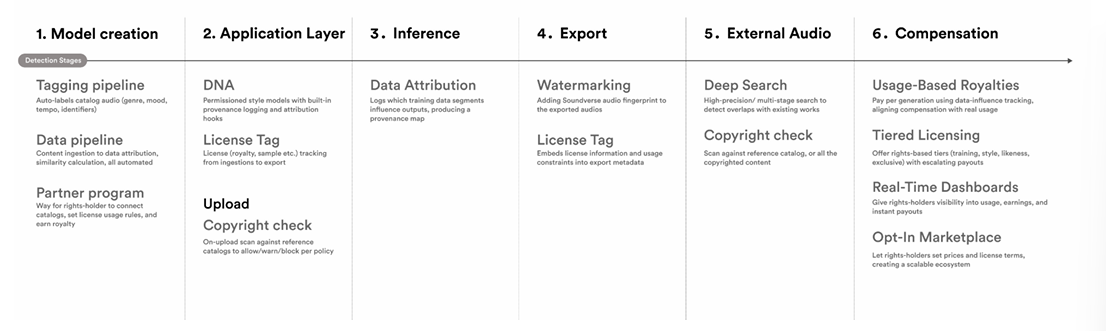
At the forefront of this transformation stands Soundverse The Ethical AI Music Framework — a comprehensive infrastructure created to unify innovation and artist integrity. Rather than operating as a black-box AI model, it implements transparent methodology across every stage of music generation.
Six-Stage Transparency Pipeline
- Licensed Data Sourcing (No Scraping): Soundverse begins with legally obtained and consented datasets. Every contribution passes through a licensing protocol to ensure compliance.
- Permissioned Models (DNA): Each trained model carries verifiable permission metadata. This ensures that music stems and patterns are linked back to approved catalogs.
- Explainable Inference (Attribution): Every generated track reveals how the AI derived its output. Artists can trace which licensed elements influenced the composition.
- Traceable Export (Watermarking): After generation, invisible watermarks preserve authorship data — preventing misuse and ensuring proper ownership tracking.
- Deep Search (External Scanning): This mechanism scans external databases to detect unauthorized replication of licensed works.
- Recurring Compensation (Partner Program): Creators receive ongoing royalties connected to AI-generated works made from their contribution library.
Together, these stages replace outdated opaque systems with a verifiable and ethical creative ecosystem.
The framework integrates with Soundverse Trace for continuous audio attribution and deep rights tracking across an artist’s entire portfolio. Moreover, Soundverse DNA supports stylistic replication under full consent, allowing musicians to extend their sonic identity ethically.
For producers seeking enterprise-scale workflows or independent artists training compact style models, The Ethical AI Music Framework represents the world’s most transparent infrastructure for responsible AI creation in 2026. It bridges ethical design and innovation to ensure that the artistic voice remains central, even amid exponential technological growth.
Start Creating Authentic AI Music Today
Unlock the power of Soundverse to generate unique, emotion-driven music effortlessly. Blend genuine artistic vision with cutting-edge AI tools and elevate your creative process.
Create with Soundverse
Related Articles
- How AI-Generated Music Is Transforming the Music Industry: Discover how AI innovations are reshaping how artists produce, distribute, and innovate within the modern music landscape.
- AI Music Generator and Human Composers: A Future Together: Explore how AI music generators and human creativity can collaborate for richer and more dynamic compositions.
- The Role of AI Music in Film and Television: Learn how AI-generated music is revolutionizing soundtracks and background scores for film and TV productions.
- How an AI Music Generator Inspires Creative Fusion: Find out how AI-driven composition tools inspire new forms of collaboration and creativity across genres.
Here's how to make AI Music with Soundverse
Video Guide
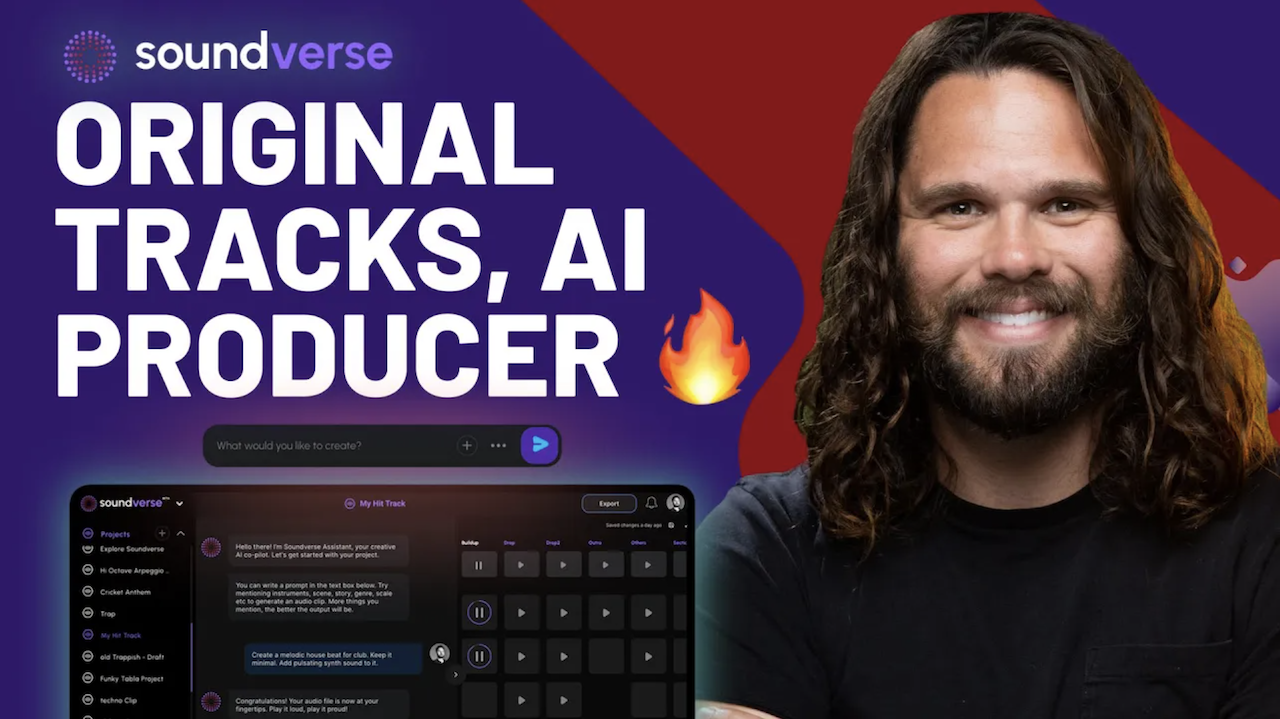
Here’s another long walkthrough of how to use Soundverse AI.
Text Guide
- To know more about AI Magic Tools, check here.
- To know more about Soundverse Assistant, check here.
- To know more about Arrangement Studio, check here.
Soundverse is an AI Assistant that allows content creators and music makers to create original content in a flash using Generative AI. With the help of Soundverse Assistant and AI Magic Tools, our users get an unfair advantage over other creators to create audio and music content quickly, easily and cheaply. Soundverse Assistant is your ultimate music companion. You simply speak to the assistant to get your stuff done. The more you speak to it, the more it starts understanding you and your goals. AI Magic Tools help convert your creative dreams into tangible music and audio. Use AI Magic Tools such as text to music, stem separation, or lyrics generation to realise your content dreams faster. Soundverse is here to take music production to the next level. We're not just a digital audio workstation (DAW) competing with Ableton or Logic, we're building a completely new paradigm of easy and conversational content creation.
TikTok: https://www.tiktok.com/@soundverse.ai
Twitter: https://twitter.com/soundverse_ai
Instagram: https://www.instagram.com/soundverse.ai
LinkedIn: https://www.linkedin.com/company/soundverseai
Youtube: https://www.youtube.com/@SoundverseAI
Facebook: https://www.facebook.com/profile.php?id=100095674445607
Join Soundverse for Free and make Viral AI Music
 We are constantly building more product experiences. Keep checking our Blog to stay updated about them!