AI Music and Artist Ownership Explained: Understanding Rights in 2026
Learn how AI music ownership and artist rights are defined in 2026.
AI Music and Artist Ownership Explained
Artificial intelligence continues to reshape the creative industries, and nowhere is this transformation more visible than in music. By 2026, AI-generated songs have become a standard tool for composers, producers, and even casual creators. Yet with this innovation comes a complex debate: who owns AI music, and how do artist rights and music copyright operate in a world where machines generate melodies? In this article, we explore AI music ownership and the evolving concept of intellectual property in music, culminating in how Soundverse addresses these challenges through its Ethical AI Music Framework.
What does AI music ownership mean in 2026?
AI music ownership refers to the legal and ethical structures determining who controls music created by artificial intelligence systems. The question, once theoretical, became mainstream around 2024, when generative AI platforms began producing full songs indistinguishable from human compositions. By 2026, courts, copyright offices, and industry experts have moved toward clearer rules that separate authorship from data contribution and AI tool operation.
Ownership typically depends on three main factors: the person or entity initiating the AI creation, the dataset used to train the model, and the level of human creativity involved in the final composition. If an artist describes the desired style and melody, their creative input may qualify as authorship. Conversely, when a system generates a track autonomously without scripted intent, the resulting work may fall under shared ownership or data-license-based models, as explained in the AI Music Copyright 2026: Complete Legal Guide for Creators.
These distinctions form the foundation for fair music copyright practices in the AI era.

How are artist rights being protected in the age of AI music?
Artist rights remain at the heart of this discussion. Musicians and producers are concerned not only about reproduction and sampling but also about how their unique sonic signatures are embedded into AI models. 2026 policies emphasize transparency and consent, driven by demand from both creators and legal institutions, as noted in Music and AI: 2025's developments that will shape 2026's disputes.
Modern frameworks define artist rights in the AI music industry as including:
- Data usage consent – Artists must approve AI training that uses their music.
- Attribution acknowledgment – When AI models leverage stylistic DNA from licensed tracks, credited artists retain visible attribution.
- Monetization and recurring royalties – Rights holders receive continuous payments for any AI-generated songs utilizing their contributed datasets.
- Model explainability – AI systems should disclose the data sources influencing output composition.
These principles reduce exploitation and ensure musicians retain control over their creative legacy.

What are current trends in music copyright and AI-generated songs?
By 2026, music copyright laws have adapted to include AI participation clauses. Several nations have implemented frameworks allowing registration of AI-assisted works, stating that while an AI cannot be the “author,” the human directing the process may claim ownership of the generated result, as highlighted in How Copyright Office Guidance Applies to Music That Includes AI-Generated Material.
AI-generated songs now fall into two categories:
- AI-Assisted Works, which involve clear human authorship and guidance.
- Fully Autonomous Works, produced entirely by AI systems with no creative human input.
In AI-assisted cases, copyright applies normally to the human creator. Fully autonomous works may instead be covered by licensing arrangements between model owners and artists whose data trained the system. This ensures that intellectual property in music continues to be traceable even in nonhuman contexts.
You can find examples of how this transition unfolded in earlier AI platforms — see how systems like Soundverse evolved compared to Mubert alternatives and Soundraw alternative use cases.
For a deeper dive into creative workflow tutorials, watch our guide on creating Deep House music and how to make music from the Soundverse Tutorial Series.
How do creators navigate intellectual property in music created by AI?
For artists and entertainment lawyers, navigating AI music ownership requires understanding how intellectual property law interacts with machine creativity. The essential questions include:
- Who initiated the generative process?
- Does the output include identifiable copyrighted material?
- Was the training data licensed or scraped?
- What compensation models are implemented?
Modern enterprises now adopt transparent systems making these questions easier to answer. Detailed attribution logs and watermarking help verify provenance, establishing stronger evidence trails for copyright compliance. Creators should seek platforms offering consent-based AI models and verifiable metadata stamps across every stage of music generation.
Industry articles, like how AI-generated music is transforming the music industry, provide insights into how these elements evolved between 2024 and today, shaping recording contracts and licensing norms. Check out our tutorial on the "Explore" tab to discover interactive generation tools used by artists adapting to these frameworks.
What risks come from unlicensed AI music creation?
Using unlicensed datasets exposes companies and individuals to severe copyright infringement risks. Many 2024-2025 models faced backlash for training on publicly available songs without permission, resulting in takedown requests and lawsuits. In 2026, major studios and tech companies adopted strict compliance protocols ensuring every sample and track used during AI training is registered, licensed, and attributed. The global context experienced legal pressure similar to that outlined in Dean, Moran Introduce Bipartisan Bill to Protect Creators from Unauthorized AI Training.
The global music community demands enforcement of artist rights as machine models grow more advanced. Transparency technology, watermarking, and traceable export mechanisms have become standard regulatory expectations. Creators now prioritize tools that guarantee ethical compliance rather than relying on opaque black-box generators.
How Soundverse’s Ethical AI Music Framework redefines AI music ownership
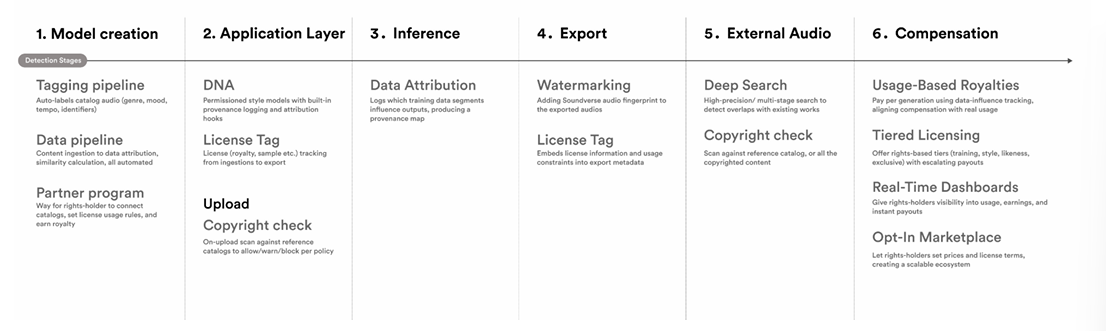
Soundverse introduced the Ethical AI Music Framework, a comprehensive end-to-end infrastructure bridging innovation and artist integrity. It replaces opaque processes with a transparent six-stage pipeline ensuring consent, attribution, and recurring compensation.
The six stages of trust in AI music
Stage 1: Licensed Data Sourcing – All musical data used for model training is licensed, eliminating scraping and unauthorized content collections.
Stage 2: Permissioned Models (DNA) – Artists participate directly by licensing their style and sonic identity. Soundverse DNA enables training using approved catalogs, ensuring compliance and monetization for every contributor.
Stage 3: Explainable Inference (Attribution) – The system records creative lineage, specifying which licensed styles or datasets influenced results. This transparency resolves authorship disputes and supports ethical auditing.
Stage 4: Traceable Export (Watermarking) – Every generated track embeds a secure watermark carrying metadata about dataset origin, attribution credits, and license status.
Stage 5: Deep Search (External Scanning) – Soundverse Trace continuously scans public platforms to detect unauthorized use or derivative copies, empowering artists to maintain control.
Stage 6: Recurring Compensation (Partner Program) – Rights holders linked through the Content Partner Program receive ongoing, usage-based royalties every time their licensed data contributes to new outputs.
This architecture ensures that AI-generated songs can coexist with creative integrity, advancing clear intellectual property in music.
Soundverse’s framework embodies ethical innovation for record labels, producers, and legal entities alike. It empowers creators to safely explore AI-generated work without sacrificing ownership.
Related discussions about new creative workflows and monetization can be found in Soundverse Assistant as your AI music co-producer and AI ranks Soundverse’s AI singer 1: The Ultimate AI Singing Platform Dominating 2025.
Why transparent frameworks matter for the future of the music industry
The music industry of 2026 runs on collaborative AI. As virtual composers and hybrid artists multiply, transparent frameworks like Soundverse’s Ethical AI Music Framework ensure ethical growth. They demonstrate how AI systems can respect artist rights and legal standards while advancing creativity.
Transparent ownership tracking eliminates confusion between creators and technology providers, helping entertainment lawyers and producers maintain proper licensing. From a compliance standpoint, robust data governance and recurring royalty models prevent exploitation and sustain an equitable creative economy.
Start Creating and Owning Your AI Music Today
Unlock your creative potential with Soundverse’s powerful AI tools. Generate professional-quality tracks, maintain artistic control, and understand your ownership rights—all in one intuitive platform.
Create Your AI Music Now
Related Articles
- How AI-Generated Music Is Transforming the Music Industry — Discover how AI technology is changing the way artists compose, produce, and distribute their music.
- Copyright-Free vs. Royalty-Free Music: What Creators Should Know — Learn the key differences between copyright-free and royalty-free music, and how they affect your creative rights.
- Navigating the World of Royalty-Free and Copyright-Free Music Using Soundverse AI — A step-by-step guide to finding and generating music you can safely use in your projects.
- The Role of AI Music in Film and Television — Explore how AI-generated music is redefining soundtracks and creative workflows in entertainment.
Here's how to make AI Music with Soundverse
Video Guide
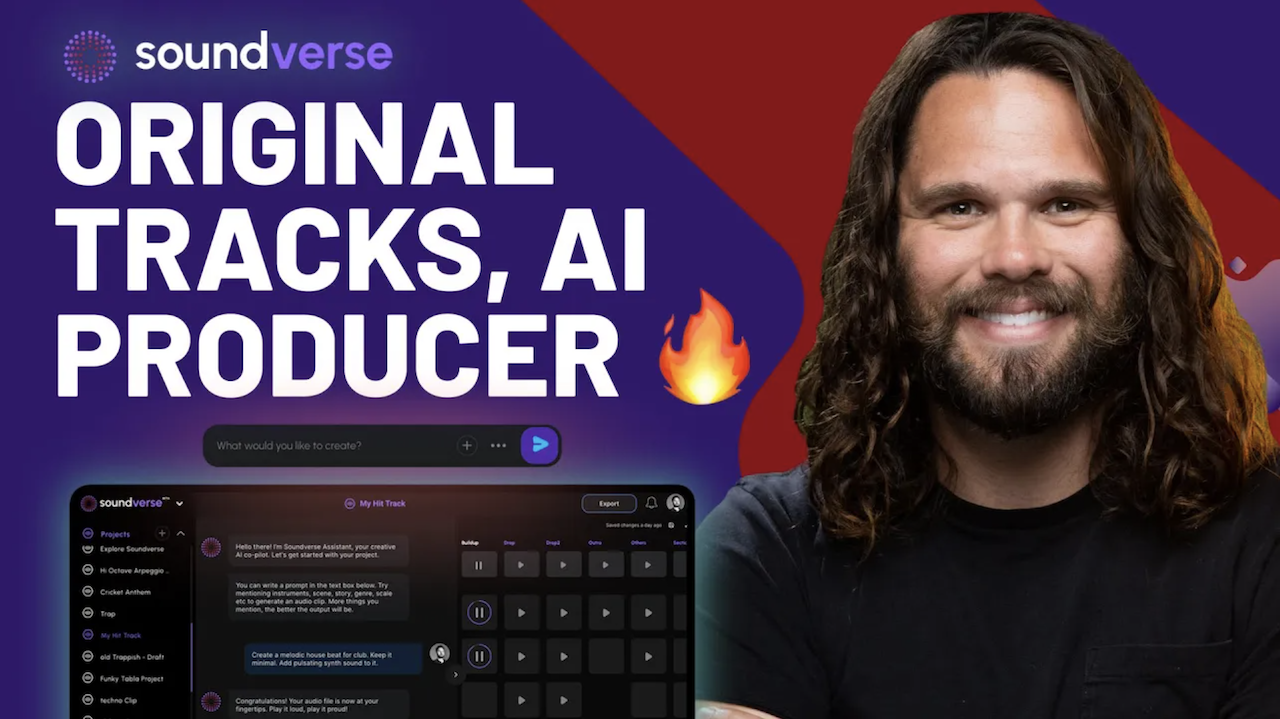
Here’s another long walkthrough of how to use Soundverse AI.
Text Guide
- To know more about AI Magic Tools, check here.
- To know more about Soundverse Assistant, check here.
- To know more about Arrangement Studio, check here.
Soundverse is an AI Assistant that allows content creators and music makers to create original content in a flash using Generative AI. With the help of Soundverse Assistant and AI Magic Tools, our users get an unfair advantage over other creators to create audio and music content quickly, easily and cheaply.
Soundverse Assistant is your ultimate music companion. You simply speak to the assistant to get your stuff done. The more you speak to it, the more it starts understanding you and your goals.
AI Magic Tools help convert your creative dreams into tangible music and audio. Use AI Magic Tools such as text to music, stem separation, or lyrics generation to realise your content dreams faster.
Soundverse is here to take music production to the next level. We're not just a digital audio workstation (DAW) competing with Ableton or Logic, we're building a completely new paradigm of easy and conversational content creation.
TikTok: https://www.tiktok.com/@soundverse.ai
Twitter: https://twitter.com/soundverse_ai
Instagram: https://www.instagram.com/soundverse.ai
LinkedIn: https://www.linkedin.com/company/soundverseai
Youtube: https://www.youtube.com/@SoundverseAI
Facebook: https://www.facebook.com/profile.php?id=100095674445607
Join Soundverse for Free and make Viral AI Music
We are constantly building more product experiences. Keep checking our Blog to stay updated about them!